

The rapid evolution of 3D printing technology has transformed industries but also raised significant intellectual property (IP) concerns.
As unauthorised reproductions become easier to produce, patent holders, trademark owners, and copyright holders face increasing legal challenges.
Our Technology and Commercial Litigation Lawyers explore the key IP risks of 3D printing and the legal remedies available to rights holders.
The Development of 3D Printing Technology
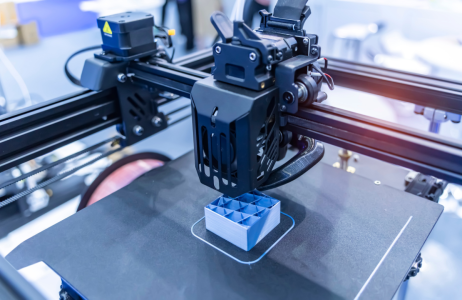
3D printing, also known as additive manufacturing, involves a machine laying down successive layers of material, such as plastics, fused to form a 3-dimensional product.
CAD (Computer-Aided Design) files hold the data, such as relevant dimensions, required for the 3D printer to construct the desired output.
Since the first patent was filed in 1986 for a historic form of 3D printing, technological advancements have significantly reduced the financial cost of 3D printers and expanded 3D printing to consumers and commercial businesses.
Equally, technological advancements in 3D printing have also broadened the capabilities of this technology, including in the aerospace industry for the creation of jet engine parts and organ transplants, as demonstrated in 1999 when scientists at the Wake Forest Institute for Regenerative Medicine used a 3D-printed bladder in an organ transplant.
In light of recent technological advancements and anticipated future advancements in 3D printer capabilities, commercial parties should be wary of potential Intellectual property (IP) infringement issues that may arise.
Intellectual Property Infringement
In November 2018, the UK Intellectual Property Office (UK IPO) published a study on ‘3D printing and intellectual property futures’.
However, at present, there is no specific legislation in the UK governing the relationship between IP and 3D printing.
Consequently, IP owners should consider existing IP infringement laws when enforcing their IP rights against infringing individuals and/or companies.

Patent Infringement
Patents provide inventors with a monopoly over their inventions. However, only a patent's proprietor, co-owner or exclusive licensee can claim patent infringement.
Considering the frequent use of 3D printers to construct parts for products, for example, in the aerospace industry, companies seeking to bring a claim for patent infringement for the construction of spare parts should be mindful of the Court’s distinction between ‘making’ (an infringing act under the Patents Act) and ‘repairing’ (which is not an infringing act).
The Schutz (UK) Ltd v Werit UK Ltd (2013) UKSC 16 decision explained that the distinction between ‘making’ and ‘repairing’ is a question of “fact and degree”.
As a result, the likelihood of patent infringement following the construction of spare parts by 3D printers will likely turn on the facts of the case.
Trademark Infringement and Passing Off
Trademarks can include names, logos and certain shapes.
Consequently, 3D printing technology can also give rise to potential trademark infringement claims where the output of a 3D printer includes a registered mark.
Trademark Infringement under the Trade Marks Act 19994 occurs when the infringer:
- Uses a sign which is identical to another person’s trade mark in respect of identical goods;
- Uses a sign which is identical to another person’s trade mark, in respect of similar goods, and there is a likelihood of confusion;
- Uses a sign which is similar to another person’s trade mark. In respect of identical or similar goods, and there is a likelihood of confusion; and/or
- Uses a sign that is identical or similar to another person’s trademark, has a reputation in the UK, and takes unfair advantage of or is detrimental to the character of the trademark's reputation.
Despite rapid technological developments in 3D printing, the potential brand damage caused by poor-quality 3D printed products may justifiably lead to trademark owners seeking an injunction, delivery up of goods and/or damages against the infringing party.
Because trademark registration for 3D shapes is difficult, a claim for passing off is more likely to be applicable where 3D printers have created similarly shaped products.
In order to demonstrate passing off, a claimant must demonstrate that:
- the goods have goodwill attached to them
- there has been misrepresentation, which leads to the public believing that the goods belong to the claimant and
- that damage has been caused to the claimant.

Copyright Infringement
It has also been suggested that the CAD files containing the necessary data to instruct a 3D printer may equally be subject to copyright protection.
The potential extension of copyright to CAD files is particularly valuable for users of 3D printing technology since copyright protection is granted automatically and lasts for the lifetime of the creator plus 70 years.
Copyright infringement claims may, therefore, apply to 3D printing technology if a CAD file is copied or distributed without the developer’s consent.
The Growing Importance of IP Protection in 3D Printing
The 3D printing industry has experienced significant technological advancements in recent decades.
Given these advancements, Intellectual Property rights are anticipated to become increasingly valuable in the manufacturing and scientific development industries.
Interested parties should, therefore, seek legal advice to protect their IP and enforce any existing IP.
Contact Our Intellectual Property Dispute Solicitors
Protecting your intellectual property in the evolving world of 3D printing is crucial to safeguarding your rights and innovations.
Contact our expert Commercial Litigation and IP lawyers today for tailored legal advice on enforcing and securing your intellectual property.
01619414000
More Technology Law News and Advice

Commercial Contracts in 2026: 5 Key Trends in AI, Data Protection & Technology Risk
At our recent webinar, Commercial Contracts in 2026 | AI, Data Protection & Technology Risk , Richard Meehan , Partner in the Myerson Commercial Team and Head of the Technology Sector Group, explored five key themes shaping commercial contracts in 2026. The session focused on the practical issues arising from the complex, rapidly changing nature...
Read Blog
Deepfakes & Data: The UK Privacy Reckoning for AI-Generated Imagery
With the continued development of AI and the lack of overarching regulation in England and Wales, questions arise about whether more stringent measures are needed, particularly given the recent rise in non-consensual image and video generation featuring the likeness of individuals. Our Commercial Solicitors outline the current regulation of AI in...
Read Blog
Compliance for Online Businesses Under the DMCCA
The Digital Markets, Competition and Consumers Act 2024 ( DMCCA ) came into force earlier this year on 6 April 2025 as a significant update to the UK’s consumer rights regime. Businesses that sell to consumers must ensure that they comply with the statutory requirements for consumer contracts, including the prohibition of fake reviews and other...
Read Blog
AI Patent Law Shift on the Horizon? Latest Update on the Emotional Perception AI Case
Last month saw the Supreme Court hear the appeal of Emotional Perception AI Limited (‘EPAI’) concerning its attempt to patent its neural network-based system for recommending music files. In this blog, our Technology Lawyers explore the case.
Read Blog
International Transfers of Personal Data - Update to EU Adequacy Decisions
Under the EU’s data protection regime, the European Commission is authorised to determine whether a country outside the EU, such as the UK, offers an adequate level of protection for personal data to allow the personal data of EU data subjects to be exported to that country without the use of additional measures between the organisations...
Read Blog
Launching Smart: What Every Tech Startup Must Know
Our Technology S olicitors regularly assist tech startups by providing hands-on, bespoke legal assistance throughout the journey of the startup business to facilitate growth and innovation. At the early stages of your startup , it is vital to the success of your business to receive a solid footing and the correct legal advice from the outset...
Read Blog
James Banks
Trainee Solicitor
James joined as a Trainee Solicitor at Myerson in 2024. Prior to joining the firm, James graduated from Durham University with a First Class Honours LLB. He is currently completing the SQE qualification with BPP University in Manchester.
About James Banks