


The Employment Rights Act 2025 (ERA 2025) received Royal Assent on 18 December 2025.
It amends the law relating to employment rights to enhance employee protections, bringing major changes throughout 2026 and 2027.
With key provisions now in force and further reforms due to take effect throughout 2026 and 2027, our Employment Lawyers outline the key changes employers should be aware of and the steps they should take to prepare.
Looking for practical advice? Read our Top 10 Tips for Employers on the Employment Rights Act 2025.
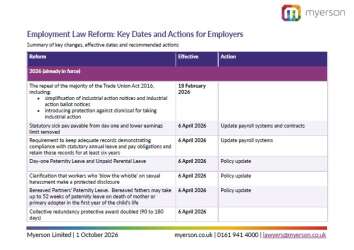
The Reforms at a Glance
| Change | When it Takes Effect | Action Needed Now |
|---|---|---|
| Statutory sick pay payable from day one; lower earnings limit removed | 6 April 2026 | Update sickness policies and payroll |
| Holiday and holiday pay record-keeping (six-year duty) | 6 April 2026 | HR systems must capture and retain information |
| New day-one family and parental leave rights | April 2026 | Review policies and train managers |
| Collective redundancy protective award doubled (90 to 180 days’ pay) | 6 April 2026 | Update policies and comply |
| National living wage and statutory rate rises | April 2026 | Update pay rates and payroll |
| Tribunal claim time limits extended (3 to 6 months) | 1 October 2026 | Strengthen note taking and keep key documents |
| Trade union rights of access to workplaces | 30 October 2026 | Review new rules and prepare for access requests |
| Duty to take all reasonable steps to prevent sexual harassment; third-party harassment | 30 October 2026 | Review harassment policies and training. Update risk assessment. |
| Written statement of the right to join a trade union | 1 January 2027 | Prepare now for annual communication as per new government guidance |
| Strengthened tipping law (duty to consult workers) | Planned by the end of 2026 | Prepare now - review existing tipping arrangements pending guidance |
| Unfair dismissal: six-month qualifying period and removal of compensation cap | 1 January 2027 (affecting hires from July 2026) | Ensure robust recruitment and probation processes |
| Equality action plans (employers with 250+ staff) | 2027 | Prepare voluntarily now |


October 2026 Changes
A number of further key employment law changes take effect in October 2026.
The main reforms are outlined below:
Employment Tribunal Limits
Previously, individuals generally had three months to bring a claim to an Employment Tribunal.
The ERA 2025 extended the time limit for individuals to bring Employment Tribunal claims from three to six months, effective from 1 October 2026.
This change is widely expected to increase the number of Employment Tribunal claims brought.
What should employers do?
Employers should keep clear, accurate records, particularly since relevant documents and evidence may need to be retained for longer.
Trade Unions
With effect from 30 October 2026, trade unions will have brand-new rights of physical and digital access to workplaces for purposes including representation, recruitment, and collective bargaining.
This new right is subject to a detailed request procedure, including short response times.
Employers should be able to respond to such requests and take action and advice at an early stage.
Employers are also advised to carefully review their employee engagement strategy and consider which organisations (internal or external) and what arrangements optimise the capture of employee voice.
From 30 October 2026, employers will also be required to provide workers with a written statement informing them of their right to join a trade union.
Employers should prepare to update contracts and written statements once government guidance on the new requirement is available.
Harassment
Employers will undoubtedly be aware of their existing obligations to take ‘reasonable steps’ to prevent sexual harassment of their employees.
However, from 30 October 2026, the ERA 2025 expands this obligation, requiring employers to take ‘all reasonable steps’ to prevent sexual harassment.
Further regulations setting out what steps employers will be expected to take are due in 2027; however, the general consensus is that these requirements are likely to be more onerous for employers.
Additionally, from October 2026, employers will be liable for harassment by third parties, such as clients or suppliers, unless they can demonstrate that they took all reasonable steps to prevent it.
From April 2026, reporting sexual harassment can count as whistleblowing. Separately, the Act will ban confidentiality clauses that stop staff from speaking up about harassment or discrimination, making such clauses void. This is expected to take effect in 2027.
Previous Changes from April 2026
A number of key employment law changes take effect in April 2026.
The main reforms are outlined below:
Trade Union Levy
Current law
The Trade Union Act 2016 allows the Certification Officer (“CO”) to charge an annual levy on trade unions and listed employers’ associations. The levy is calculated mainly by the size of the organisation (such as membership levels), so larger unions pay more. This levy contributes to the CO’s regulatory functions.
New law under the ERA 2025
The ERA will repeal the annual levy that trade unions and employer associations pay to the CO. It removes the requirement for the CO to report on the levy and removes the Secretary of State’s power to impose such a levy in future.
Date of change
1 April 2026
What should employers do?
Employers do not generally need to take any specific action. From 1 April 2026, payments to the CO cease and the regulator returns to government funding.
Collective Redundancy Protective Award
Current law
Under the current law, employers proposing to dismiss 20+ employees at one establishment within a 90-day period must carry out collective consultation with appropriate employee representatives. If the employer fails to comply, affected employees may bring a claim and the tribunal may award up to 90 days’ gross pay per affected employee.
New law under the ERA 2025
The maximum protective award for an employer’s failure to collectively consult about redundancies will double from 90 to 180 days’ pay.
Date of change
6 April 2026
What should employers do?
Employers should keep accurate records of any redundancies made and proposed to help identify when the relevant threshold might be triggered, as well as taking legal advice, so as to avoid the risk of claims for this increased protective award.
Paternity Leave
Current law
Currently, statutory paternity leave requires 26 weeks’ continuous service with an employer by the 15th week before the baby is due or the adoption placement. Statutory paternity pay also requires 26 weeks’ service, but this will remain unchanged.
New law under the ERA 2025
Paternity leave (not statutory paternity pay) will become a day one right for eligible employees. In addition, employees will be able to take statutory paternity leave after a period of shared parental leave.
Date of change
6 April 2026
What should employers do?
Employers should review and update policies on paternity leave and consider any impact on contractual enhancements.

Unpaid Parental Leave
Current law
Unpaid parental leave requires one year of continuous service to qualify.
New law under the ERA 2025
Subject to the other eligibility criteria, unpaid parental leave will become a day-one right.
Date of change
6 April 2026
What should employers do?
Employers should review and update policies on parental leave and consider any impact on contractual enhancements, if any.
Whistleblowing and Sexual Harassment
Current law
Under the ERA 1996, a worker is protected from dismissal or detriment if they make a qualifying protected disclosure (meaning they disclose information which they reasonably believe shows a type of wrongdoing, and that disclosure is made in the public interest). Sexual harassment is not currently included as a type of qualifying disclosure.
New law under the ERA 2025
Whistleblowing legislation will be amended so that the definition of qualifying disclosure includes a worker making a disclosure that sexual harassment has occurred, is occurring or is likely to occur. This provides clarification that workers who report such conduct are protected.
Date of change
6 April 2026
What should employers do?
Employers should amend whistleblowing policies to ensure that complaints of sexual harassment are explicitly referred to as a type of information which can be a qualifying disclosure, and also refresh training for employees and managers on whistleblowing protection and policies.
Statutory Sick Pay
Current law
Currently, the Statutory Sick Pay (“SSP”) regime requires employees to serve three unpaid “waiting days”, meaning SSP is only payable on the fourth consecutive day of sickness, and employees must earn at least the lower earnings limit (£125 per week) to qualify for SSP.
New law under the ERA 2025
The waiting period will be abolished and SSP will be payable from the first day of absence. There will also be no lower earnings limit, with the rate of SSP to be the lower of the statutory SSP rate and 80% of normal earnings.
Date of change
6 April 2026
What should employers do?
Employers should budget for higher statutory sick pay costs and consider amending any company sick pay schemes which are currently drafted around the SSP framework.

Gender Equality and Menopause Action Plans
Current law
There is currently no obligation for employers to produce a gender equality action plan or a menopause support action plan.
New law under the ERA 2025
Employers are asked to voluntarily create action plans on gender equality and supporting employees through the menopause. From 2027, these will become mandatory for employers with 250+ employees.
Date of change
6 April 2026
What should employers do?
As best practice, employers should consider and create the action plans now, in readiness for them becoming mandatory in 2027.
Menopause Guidance
Current law
In March 2026, the government published employer guidance to support the rollout of the ERA 2025 provisions on menopause action plans. In 2019, ACAS also published guidance on menopause and the workplace.
New law under the ERA 2025
The government will release further employer guidance on creating action plans for supporting employees going through the menopause.
Date of change
6 April 2026
What should employers do?
Employers should refer to the guidance in readiness for creating the voluntary menopause action plans in April 2026 and the compulsory plans in 2027 (see above).
Trade Union Recognition
Current law
Under the current regime, a union must demonstrate that a majority of workers in the proposed bargaining unit are likely to support recognition, and if the case proceeds to a ballot, the union had to win a majority of the votes cast, and those votes had to represent at least 40% of all the workers in the bargaining unit.
New law under the ERA 2025
The ERA 2025 is simplifying the trade union recognition process. Unions no longer have to show likely majority support at the application stage, and the 40% requirement has been removed, so a simple majority of votes cast is enough for recognition. Also, the threshold for the recognition application can be set lower (potentially between 2% and 10% of the bargaining unit).
Date of change
6 April 2026
What should employers do?
Employers do not need to take any specific action in response to this change, but must be aware that there will be more scope for trade unions to be recognised and to widen the bargaining units. Employers should ensure they have good relationships with their trade unions and have employee consultancy bodies with which they engage regularly.

Bereaved Partner’s Paternity Leave
Current law
Under the ERA 1996, bereaved fathers or partners have no special statutory entitlement and are limited to the ordinary paternity leave (two weeks leave subject to a 26-week service requirement) where the mother or adopter of a child dies within one year of childbirth or adoption.
New law under the ERA 2025
Although not part of the ERA, changes to bereaved partners’ paternity leave are proposed to come into force at the same time as other ERA changes. It will provide a right of up to 52 weeks' bereaved partner's paternity leave where the child's primary carer (usually the mother or other adoptive parent) has died within 52 weeks of the birth or adoption placement. This will apply where the bereavement takes place on or after 6 April 2026.
Date of change
6 April 2026
What should employers do?
Employers should amend their paternity policies and consider any impact or interaction with any company paternity pay.
Annual Leave Record Keeping
Current law
There is currently no specific statutory duty for employers to keep detailed annual leave records.
New law under the ERA 2025
Employers will be under a statutory duty to keep adequate records of workers’ statutory annual leave entitlement and the annual leave actually taken, including:
• paid statutory leave;
• any carried over leave;
• any leave accrued under the irregular hours or part year worker regimes.
Date of change
6 April 2026
What should employers do?
Employers should ensure they have robust systems in place to record statutory annual leave accrual, taken leave, and any carry over.
Employers should update policies and internal processes to reflect the new record keeping obligations.
Vento Bands
Previous bands (6 April 2025 to 5 April 2026)
The following bands (known as the “Vento bands”) apply to injury to feelings awards in discrimination and whistleblowing claims.
The bands were:
- Lower band: £1,200 to £12,100
- Middle band: £12,100 to £36,400
- Upper band: £36,400 to £60,700
- Exceptional cases: £60,700+
Updated tribunal guidance (from 6 April 2026)
The Vento bands are not set by the ERA 2025. They are updated each April by the Presidents of the Employment Tribunals in line with inflation. The updated bands, published on 30 March 2026, are:
- Lower band: £1,300 to £12,600 (less serious cases)
- Middle band: £12,600 to £37,700
- Upper band: £37,700 to £62,900 (the most serious cases)
- Exceptional cases: £62,900+.
Date of change
6 April 2026
What should employers do?
Employers should be aware of the increases to the Vento bands and budget slightly higher for any potential claims and settlements and also adjust settlement strategies accordingly. It’s also always a good idea to do refresher training for managers on discrimination in the workplace and handing grievances etc.
Fair Work Agency
Current law
At present, the majority of employment rights are enforced by individuals bringing a claim in an employment tribunal. Some limited rights are enforced by the state on behalf of workers but via a fragmented group of bodies.
New law under the ERA 2025
The ERA creates a new public enforcement body called the Fair Work Agency, replacing all existing enforcement functions spread across different bodies. This will enforce national minimum wage, holiday pay, statutory sick pay, modern slavery, and agency worker rights.
Date of change
7 April 2026
What should employers do?
Employers should consider undertaking an internal audit to ensure compliance in respect of national minimum wage, holiday pay, SSP, modern slavery and agency worker rights.
What changes has the ERA 2025 already brought into force?
December 2025
On 18 December 2025, the ERA 2025 immediately repealed the Strikes (Minimum Service Levels) Act 2023, which set minimum service levels for strikes in key/emergency sectors.
Employers do not need to take any specific action regarding this change, however, it is important to ensure you have a good relationship with your trade unions or have employee consultancy bodies which you engage with regularly.
February 2026
On 18 February 2026, the ERA 2025 repealed the vast majority of the Trade Union Act 2016, simplifying requirements on trade unions in respect of ballot and action notices. The ERA 2025 reduced the notice for strike action from 14 days to 10 days and increased the mandate for strike action from 6 months to 12 months. It also reduced the amount of information that trade unions are required to give in notices to ballot and notices of strike action.
Employers with recognised trade unions should be aware that strikes may become more frequent and more difficult to challenge on validity grounds where there is a dispute.

Watch Our Employment Law Spring 2026 Update
This session covers the implications of the Employment Rights Act 2025, upcoming legislative changes, AI in the workplace, discrimination risks, and practical steps employers should take to remain compliant and mitigate risk.
Further Changes Expected in 2027
A number of further significant employment law changes are expected to take effect in 2027.
Whilst some of the detail remains subject to further regulations and government guidance, employers should be aware of the key reforms and consider what steps they can take now to prepare.
Non-Disclosure Agreements
The ERA 2025 will make void any confidentiality clause that prevents workers from speaking up about harassment or discrimination. This is expected to take effect in 2027, with the exact date still to be confirmed.

Unfair Dismissal Rights and Compensation
Following pushback from the House of Lords against ‘day-one unfair dismissal rights’, the last-minute changes to the Bill ultimately mean that employees will gain the right not to be unfairly dismissed after a qualifying period of six months.
It is currently anticipated that this qualifying period will take effect from 1 January 2027, meaning in practice that employees commencing work from 1 July 2026 should qualify for this protection under the current implementation timetable. Employers may therefore wish to consider introducing appropriate probationary periods or reviewing existing probationary procedures to assess the performance of new starters regularly.
The removal of the current statutory cap on unfair dismissal compensation was a last-minute alteration to the Government’s initial proposals and is presently assumed to be implemented at the same time as the qualifying period reform (1 January 2027).
This change aligns unfair dismissal claims with discrimination and whistleblowing claims, which also do not have an upper limit on compensation.

Collective Redundancies
The current threshold for collective redundancy consultation is triggered when employers propose 20 or more redundancies “at one establishment” within a period of 90 days.
The ERA 2025 introduces an additional threshold, which will involve a second trigger for collective redundancy consultation obligations alongside the existing threshold. Whilst this second threshold will be set out in future regulations expected in 2027, it is envisaged that it will involve a number of redundancies across an employing entity.
Employers should also be mindful that the cap on the protective award for non-compliance with collective consultation obligations has already increased from 90 to 180 days’ pay per employee from April 2026 (see April 2026 updates above).
As a result, taking legal advice on collective redundancies will become increasingly important to ensure compliance as the further reforms are introduced.

Fire and Rehire
‘Fire and Rehire’ reforms introduced by the ERA 2025 will restrict an employer’s ability to impose changes to key contractual terms (pay, working hours, pension and holiday entitlements or anything else specified in future regulations) as it will become automatically unfair to dismiss an employee for refusing to agree to changes to key contractual terms, except in extreme circumstances of financial difficulty.
Furthermore, the ERA 2025 extends ‘fire and rehire’ provisions to ‘fire and replace’ scenarios where contractors or agency workers replace employees to complete substantially the same work.
The fire and rehire/fire and replace reforms are due to be implemented in 2027, following which employers will have less flexibility to change key contractual terms.

Zero-Hours Contracts
Under reforms to zero-hours contracts expected in 2027, employers will be obliged to offer an employment contract with guaranteed hours to ‘qualifying workers’.
The exact details of this reform will be shaped by consultation and future regulations, but the overall purpose is to provide workers with greater predictability of the hours they work.
Additionally, employers will be required to provide reasonable notice of both shifts and shift cancellations for zero-hour and agency workers.
If there is a shift change at ‘short notice’, employers will be required to make a proportionate compensation payment.
However, as with the guaranteed hours provisions, what constitutes ‘reasonable notice’, ‘short notice’, and the compensation payment will be discussed in consultation and outlined in future regulations.

Family Rights and Flexible Working
Further reforms to family rights are expected in 2027, including changes to parental bereavement leave and enhanced dismissal protections for pregnant employees and those returning from family leave.
Parental bereavement leave will be extended to include the loss of other family members and to cover early pregnancy loss. The precise details of which family relationships will be covered by the bereavement leave provisions will be addressed by future regulations.
The ERA 2025 also provides for the extension of current enhanced redundancy protections for pregnant women and those returning from family leave, which currently require these individuals to be prioritised in being offered a suitable alternative vacancy in redundancy situations.
Under the ERA 2025, any dismissal of pregnant employees, those on maternity leave and within six months of their return to work from maternity leave will be prohibited, except in specific circumstances determined by future regulations.
The ERA 2025 also provides for similar enhanced dismissal protections for employees returning from other forms of family leave, including adoption or shared parental leave.
Employers should be mindful of these forthcoming changes and may wish to review and update their family leave and redundancy policies ahead of their implementation.
The removal of the qualifying periods for paternity leave and unpaid parental leave has already taken effect from April 2026 (see April 2026 updates above).

Equality Reporting
Employers with 250 or more employees will be required, initially on a voluntary basis from 2026 before becoming mandatory in 2027, to publish equality action plans on the gender pay gap and on supporting employees through the menopause.
Employers should also note that the UK Government is also considering a separate requirement for ethnicity and disability pay gap reporting for large employers, which will be the subject of individual legislation.

What does this mean for employers?
The changes introduced by the ERA 2025 will have a significant impact on employers, with further reforms still due to take effect throughout 2026 and 2027.
Employers should continue to review their policies and procedures, document key employment decisions carefully and ensure that HR teams and managers are prepared for the forthcoming changes.
If your business requires assistance with updating policies and obtaining employment law advice, please contact our specialist Employment Team.

Comment
The Employment Rights Act 2025 provides a significant package of reforms to UK employment law.
With further key changes due to take effect in October 2026 and throughout 2027, employers should use this time appropriately to plan ahead, review relevant policies and procedures, and monitor the introduction of further regulations and government guidance.
Prepare Your Business for the Employment Rights Act 2025
Our specialist Employment Lawyers can help you prepare for the Employment Rights Act 2025 and the reforms taking effect from 2026 and beyond.
0161 941 4000
Latest Myerson Employment Law News

Myerson Magazine Autumn 2026 Issue
Welcome to the latest edition of Myerson Magazine, where we share practical legal advice, expert insights and news from across Myerson Solicitors. In this issue, we cover some of the important legal considerations that arise at different stages of life, from protecting family wealth and planning for the next generation to understanding your...
Read Newsletter
AI In the Workplace: Employment Law Risks Employers Should Be Aware Of
AI is very quickly changing the way the modern workplace operates. It is being used for streamlining the recruitment process, analysing productivity and absence data, drafting documents and helping with various other routine administrative tasks. In the UK, the rate of adoption of AI by companies has increased greatly with survey findings showing...
Read Blog
Employment Law Autumn Update
With significant employment law reforms approaching, employers need to understand not only what is changing but also the practical steps they should be taking to prepare their organisations. In this webinar, Myerson’s Employment Law specialists discuss the latest legislative developments, employment law reforms and key case law affecting UK...
Watch Webinar
Financial Services: Emerging Legal Risks and Regulatory Change
Financial services regulation continues to evolve rapidly, creating new legal, regulatory and compliance challenges for firms operating across the sector. In this webinar, Myerson’s Financial Services specialists discuss key developments affecting financial services businesses, from employment law and regulatory conduct to cryptocurrency...
Watch Webinar
Myerson Magazine Summer 2026 Issue
We're pleased to share the latest issue of Myerson Magazine, bringing together practical legal insights, updates on significant legislative changes and stories from across the firm. In this Summer edition, our experts explore the legal issues affecting individuals, families, business owners and property investors, from the Renters' Rights Act and...
Read Newsletter
Restrictive Covenants for Accountancy Firms: A Practical Drafting Checklist
Restrictive covenants can be a powerful safeguard, but they are only effective if they are well drafted and carefully tailored. Overly broad covenants that are wider than necessary are unlikely to be enforceable, leaving firms exposed precisely when they need protection the most. Our Professional Services Lawyers have created a checklist...
Read Blog
Emily Arnold
Trainee Solicitor
Emily joined Myerson as a Trainee Solicitor in 2024. Emily studied Law at the University of Liverpool, graduating with a 2:1 in 2019.
About Emily Arnold