


Have you made the changes you need to comply with the reforms already in force?
The Employment Rights Act 2025 is the most significant shake-up of employment law in decades, which is currently being implemented in phases. A first wave of changes is already in force (April 2026), with further major reforms expected from October 2026 and into 2027.
The Act reflects a deliberate policy shift, materially expanding employee protections and increasing employers' responsibilities in the day-to-day management of their workforces.
In this blog, our Employment Lawyers explore the 10 priority actions employers should be taking now.
For a comprehensive overview of changes already in force and those still to come, visit our Employment Rights Act guide.
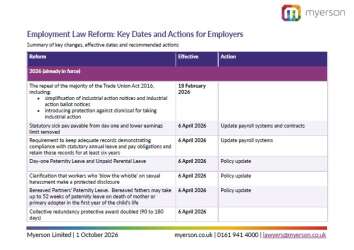
The Reforms at a Glance
| Change | When it Takes Effect | Action Needed Now |
|---|---|---|
| Statutory sick pay payable from day one; lower earnings limit removed | 6 April 2026 | Update sickness policies and payroll |
| Holiday and holiday pay record-keeping (six-year duty) | 6 April 2026 | HR systems must capture and retain information |
| New day-one family and parental leave rights | April 2026 | Review policies and train managers |
| Collective redundancy protective award doubled (90 to 180 days’ pay) | 6 April 2026 | Update policies and comply |
| National living wage and statutory rate rises | April 2026 | Update pay rates and payroll |
| Tribunal claim time limits extended (3 to 6 months) | 1 October 2026 | Strengthen note taking and keep key documents |
| Trade union rights of access to workplaces | 30 October 2026 | Review new rules and prepare for access requests |
| Duty to take all reasonable steps to prevent sexual harassment; third-party harassment | 30 October 2026 | Review harassment policies and training. Update risk assessment. |
| Written statement of the right to join a trade union | 1 January 2027 | Prepare now for annual communication as per new government guidance |
| Strengthened tipping law (duty to consult workers) | Planned by the end of 2026 | Prepare now - review existing tipping arrangements pending guidance |
| Unfair dismissal: six-month qualifying period and removal of compensation cap | 1 January 2027 (affecting hires from July 2026) | Ensure robust recruitment and probation processes |
| Equality action plans (employers with 250+ staff) | 2027 | Prepare voluntarily now |


1. Unfair Dismissal Rights
The most impactful change is that, with effect from 1 January 2027, all employees with 6 months’ continuous employment will qualify to make a claim of unfair dismissal. In addition, the cap on unfair dismissal compensatory awards will be removed.
These changes will inevitably increase the number and value of claims.
Action
Employers must urgently:
- Adopt robust recruitment processes
- Review probationary period procedures
- Manage known problem individuals without delay
- Train managers to identify, address and document issues promptly and effectively
- Ensure HR or legal advice is taken at an early stage.
Unfair Dismissal is Changing in the UK |
How Businesses Should Respond to the New Unfair Dismissal Laws in the UK |
2. Extended Periods to Make Claims
Additionally, from 1 October 2026, the period for making most Employment Tribunal claims was extended from three to six months.
This is highly likely to increase the number of claims brought. Together with extended ACAS Early Conciliation periods and delays in the Employment Tribunal system, employers may find they are dealing with cases relating to employees who left their business years before.
Action:
Employers should establish systems to keep clear records of recruitment processes, probationary reviews, disciplinary and grievance matters, performance and redundancy processes.
They should collate information, documents and witness statements as soon as a potential dispute is recognised and secure the cooperation of managers and witnesses in relation to future legal proceedings.

3. Updates to Terms of Employment
We recommend that employers review offer letters, contracts of employment and other policies to reflect a new approach to recruitment and probationary periods and to accommodate other changes discussed in this note, for example, changes to statutory sick pay and new tipping laws.
Additionally, workers must be provided with a written statement confirming their right to join a trade union. This is expected to apply from 1 January 2027, with new workers receiving it at the same time as their written statement of employment particulars.
Existing workers must receive it by 5 April 2027, after which employers must either reissue it each year by 5 April or keep it readily accessible and send an annual reminder. The government will provide a standardised statement that employers must issue and may amend only to add specified workplace information.
Action:
Employers should update template offer letters, terms and conditions and policies.
The prescribed form to be provided by the government is yet to be issued, but employers should watch for this.
Combined with recent changes in relation to union recognition procedures and new trade union rights of access (see below), employers should anticipate greater union confidence and voice in the workplace.

4. Statutory Sick Pay
From 6 April 2026, the 3-day waiting period for Statutory Sick Pay (SSP) was abolished.
SSP is now payable from the first day of absence. The lower earnings limit is also abolished, with SSP now available to all employees.
The rate of SSP is the lower of the statutory SSP rate and 80% of normal earnings.
Action:
As well as making payroll adjustments, employers should budget for higher statutory sick pay costs, update contracts of employment, and consider amending company sick pay schemes that currently reflect the SSP framework.

5. Annual Leave Record Keeping
From 6 April 2026, employers have been under a statutory duty to keep adequate records of workers’ entitlements to statutory annual leave, additional leave and holiday pay and pay in lieu of holiday for a period of 6 years.
Failure to keep adequate records is a criminal offence.
Action:
Employers should ensure they have robust systems and practices in place to record and monitor holiday and holiday pay entitlement.
This will be particularly important for atypical workers, such as those with irregular hours or part-year workers. Policies and internal processes should be updated to reflect the new record-keeping obligations and regularly audited.

6. Collective Redundancy Processes
Employers proposing to dismiss 20+ employees at one establishment within a 90-day period must carry out collective consultation with appropriate employee representatives.
Previously, a failure to comply could result in a tribunal award of up to 90 days’ gross pay per affected employee.
From 6 April 2026, the maximum award doubled from 90 to 180 days’ pay.
Action:
Further changes in this area in relation to relevant thresholds (due in 2027) and the practice of ‘fire and rehire’ (due in January 2027) mean that this is a very complex area of law.
Ongoing and planned processes may already be affected by these changes.
We recommend taking early legal advice on the statutory requirements to avoid the risk of extremely significant awards.

7. Trade Union Rights of Access
With effect from 30 October 2026, trade unions will have brand-new rights of physical and digital access to workplaces for purposes including representation, recruitment, and collective bargaining.
Action:
This new right is subject to a detailed request procedure, including short response times.
Employers should be able to respond to such requests and take action and advice at an early stage.
Employers are also advised to carefully review the employee engagement strategy and consider which organisations (internal or external) and what arrangements optimise the capture of employee voice.

8. Prevention of Sexual Harassment
From 30 October 2026, employers will be required to take all reasonable steps to prevent sexual harassment.
This proactive duty will increase the level of scrutiny on steps taken by employers before any complaint or claim of harassment arises.
Employers must also prevent third-party harassment of workers by clients, customers, suppliers, contractors or other third parties.
Action:
Employers must audit and adjust their approach to preventing harassment, including through anti-harassment policies, risk assessments, staff and manager training programmes, reporting channels and investigation procedures.
Policy review alone will not be sufficient. The focus will be on whether all reasonable preventative steps have been taken in practice.

9. Extended Rights For Parents
A number of changes benefitting parents came into force in April 2026.
New Day One rights include paternity leave (not paternity pay) and unpaid parental leave. Bereaved partners’ paternity leave also came into force, providing a Day One right of up to 52 weeks' leave where the child's mother or adoptive parent has died within 52 weeks of the birth or adoption placement.
Eligible employees also now have the right to take statutory paternity leave after a period of shared parental leave. Further enhanced protection from dismissal for pregnant women and new mothers and yet further parental rights will come into force in 2027.
The Government has also published its response to the consultation on a new Day One right to unpaid bereavement leave, which is expected to sit alongside the existing entitlement to parental bereavement leave; however, the new entitlement is broader in scope, covering a far wider range of relationships and all types of pregnancy loss before 24 weeks.
Up to two weeks' leave will be available, based on the employee's working pattern, which can be taken in discontinuous single days within 56 weeks of the bereavement.
Action:
Supporting parents in the workplace is an area of constant change. Employers must review and update policies on an ongoing basis and also consider whether adjustments are required to contractual enhancements.

10. Strengthened Tipping Law
The existing law requires employers to allocate qualifying tips, gratuities and service charges fairly and transparently, pass qualifying tips on in full, maintain a written tipping policy where tips are received more than occasionally and exceptionally, and keep records of tips received and allocated.
By the end of 2026, the tipping regime will be further strengthened, imposing a procedural obligation on employers to formally consult workers in accordance with strict statutory requirements before developing or revising their written tipping policy.
Action:
In addition to carefully observing the current law and Code of Practice, employers will be effectively restricted from making changes to tipping policies without first consulting with workers, with the aim of reaching an agreement on the tipping policy. Employers will also be required to review their written tipping policy at least once every three years, with the same consultation process applying when the review take place.

Latest Myerson Employment Law News

Myerson Magazine Autumn 2026 Issue
Welcome to the latest edition of Myerson Magazine, where we share practical legal advice, expert insights and news from across Myerson Solicitors. In this issue, we cover some of the important legal considerations that arise at different stages of life, from protecting family wealth and planning for the next generation to understanding your...
Read Newsletter
AI In the Workplace: Employment Law Risks Employers Should Be Aware Of
AI is very quickly changing the way the modern workplace operates. It is being used for streamlining the recruitment process, analysing productivity and absence data, drafting documents and helping with various other routine administrative tasks. In the UK, the rate of adoption of AI by companies has increased greatly with survey findings showing...
Read Blog
Employment Law Autumn Update
With significant employment law reforms approaching, employers need to understand not only what is changing but also the practical steps they should be taking to prepare their organisations. In this webinar, Myerson’s Employment Law specialists discuss the latest legislative developments, employment law reforms and key case law affecting UK...
Watch Webinar
Financial Services: Emerging Legal Risks and Regulatory Change
Financial services regulation continues to evolve rapidly, creating new legal, regulatory and compliance challenges for firms operating across the sector. In this webinar, Myerson’s Financial Services specialists discuss key developments affecting financial services businesses, from employment law and regulatory conduct to cryptocurrency...
Watch Webinar
Myerson Magazine Summer 2026 Issue
We're pleased to share the latest issue of Myerson Magazine, bringing together practical legal insights, updates on significant legislative changes and stories from across the firm. In this Summer edition, our experts explore the legal issues affecting individuals, families, business owners and property investors, from the Renters' Rights Act and...
Read Newsletter
Restrictive Covenants for Accountancy Firms: A Practical Drafting Checklist
Restrictive covenants can be a powerful safeguard, but they are only effective if they are well drafted and carefully tailored. Overly broad covenants that are wider than necessary are unlikely to be enforceable, leaving firms exposed precisely when they need protection the most. Our Professional Services Lawyers have created a checklist...
Read Blog
Isobel Barton
Associate
Isobel is an Associate in the award-winning Employment team at Myerson. Isobel earned a First-Class degree in the Mlaw Exempting Degree with a combined LPC from Northumbria University in Newcastle, graduating in 2019. She joined Myerson as a Trainee Solicitor in September 2022 and qualified as a Solicitor in September 2024.
About Isobel Barton