

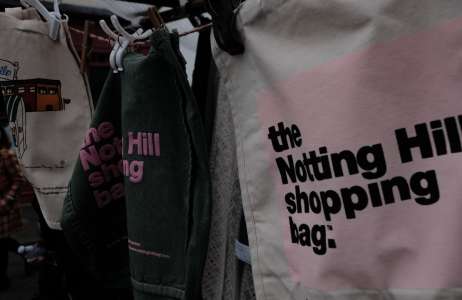
Courtenay-Smith and her company sued two brothers and their businesses, accusing them of trademark infringement, passing off, and copyright infringement related to the tote bag design she had launched in 2009.
Our IP lawyers explore the case and the important IP ownership lessons it offers for brand-led businesses.
Background
The Notting Hill Shopping Bag brand was created by journalist and entrepreneur Natasha Courtenay-Smith in around 2008–09. Natasha Courtenay‑Smith created the ‘Notting Hill Shopping Bag Company Ltd’ (‘NHSBCL’) brand in 2008–09 and registered UK trademarks for both the word mark and a figurative logo in 2013 (‘Trademarks’).
The second claimant, ‘Notting Hill Bag Company Limited’ (‘NHBCL’), was incorporated in June 2017 by Mr Canbolat An, who had been one of Natasha Courtenay‑Smith’s largest wholesale customers.
When NHSBCL was dissolved in 2018, no assignments of the trademarks or goodwill were made. As a result, all intellectual property rights vested in the Crown as bona vacantia and the Trademarks later lapsed. Natasha Courtenay‑Smith and Mr Canbolat An claimed there was a gradual transition of the business from NHSBCL to NHBCL between 2017 and 2018.
Several years later, in late 2022/early 2023, two brothers incorporated companies under the names ‘The Notting Hill Shopping Bag Company Ltd’ (‘TNHSBCL’) and ‘The Notting Hill Shopper Bag Ltd” (‘NHSBL’) and began marketing similar tote bags.
TNHSBCL and NHSBL (and the two brothers personally before their incorporation) sold products, including bags, in Notting Hill for which they sought to register trademarks in January 2023 in classes 16 and 18, which included reusable shopping bags.
The defendants claimed they developed their bag designs in 2016/2017 and had been selling them on Portobello Road since 2017, allegedly without knowledge of the claimants’ products. However, their evidence was inconsistent, and the court ultimately found that sales began around November 2022, after they had seen the claimants’ bags.
Natasha Courtenay-Smith opposed the defendants’ trademark applications on 5 June 2023. She also applied to restore the dissolved company in March 2023, while Mr Canbolat An attempted unsuccessfully to renew the trademark before its expiry in May 2023.
Following restoration in October 2023, the company purported to assign the trademark to Natasha Courtenay-Smith, who then assigned it to NHBCL. Natasha Courtenay-Smith and her company issued proceedings in the IPEC for trademark infringement, passing off, and copyright infringement.
The defendants disputed all claims, arguing that the trademark had expired, any goodwill had been extinguished on dissolution, and the copyright in the bag design had not been infringed.
Trademark infringement
The court held that Mr Canbolat An had no authority to renew the trademark. When the company was dissolved in April 2018, the mark automatically vested in the Crown as bona vacantia, meaning only the Crown could renew or authorise renewal.
Because the trademark expired in May 2023, months before the company was restored, there was no valid right capable of assignment. The subsequent assignments to Natasha Courtenay-Smith and NHBCL were therefore ineffective. No renewal was filed within the six‑month statutory grace period.
Although the defendants deliberately copied Natasha Courtenay-Smith’s bag and even incorporated a company under the same name, the infringement claim failed because NHBCL lacked standing.
Natasha Courtenay-Smith argued that NHBCL had acquired a beneficial interest through continued use, but the court rejected this. Use alone cannot create a proprietary right, and any such interest would have needed to exist before dissolution.

Revocation for non‑use
Even if the trademark had remained on the register, the court found it would have been revoked for non‑use. There was no genuine use by, or with the consent of, the Crown, the legal proprietor, between dissolution in April 2018 and expiry in May 2023.

Passing off
Passing off did not fail automatically due to the trademark issues, but NHBCL could not demonstrate protectable goodwill.
The court held that any goodwill attached to Natasha Courtenay-Smith’s original company was extinguished on dissolution in 2018 and could not be revived on restoration or assigned retrospectively.
NHBCL’s own trading activity was insufficient to show meaningful goodwill; the reputation sat with another entity, Organic Hill.
Evidence of limited sales, low social‑media presence, and incomplete financial records reinforced this conclusion. As goodwill is an essential element of passing off, the claim failed.

Copyright infringement
The court accepted that Natasha Courtenay-Smith’s logo was an artistic work, noting stylistic choices such as the use of a lowercase “t”, a full stop, a left‑justified four‑line layout, and the later removal of the dot above the “i”. Although these elements met the threshold for originality, the logo had only a narrow scope of protection due to its descriptive content.
The defendants’ designs differed substantially, using different fonts, capitalisation styles, layouts, and in one case replacing “Notting Hill” with “Camden Town.” These differences meant no substantial part of the work had been copied, and the copyright claim was dismissed.

Key lessons for businesses
Businesses must actively maintain trademarks and renewals, ensure IP is assigned before dissolving a company, preserve evidence of goodwill, and act promptly against possible infringers. Understanding the limits and scope of each IP right is crucial for effective enforcement.
Conclusion
The case illustrates how administrative oversights, particularly around dissolution and IP management, can permanently undermine enforceable rights. Proactive oversight of renewals, assignments and goodwill is essential for protecting brand assets.
Contact Our Intellectual Property Lawyers
This case highlights how easily valuable IP rights can be lost through missed renewals, poor record-keeping and company restructuring. If you would like tailored advice on protecting your trademarks, goodwill and wider brand assets, our experienced IP lawyers are on hand to help.
0161 941 4000
Latest Myerson Intellectual Property News

From TikTok to AI Digital Twins: Khaby Lame and the Future of Image Rights in the UK
In an increasingly digital and interconnected world, the commercial value and significance of personal images have grown substantially. Questions regarding who controls the use of a person’s image now arise routinely, particularly in the context of social media, digital content creation, and AI-generated likenesses. This term refers to a...
Read Blog
Research & Development Agreements: Key Legal and Commercial Issues
Research and Development (R&D) Agreements play a key role in enabling organisations to pool expertise and resources to develop new products or processes. Agreements of this nature are commonly used between commercial entities and academic institutions, and play a key role in establishing the funding models under which research takes place. With...
Read Blog
Bagging Rights Gone Wrong: The Notting Hill Tote Bag Trademark Dispute and IP Ownership Lessons
Courtenay-Smith and her company sued two brothers and their businesses, accusing them of trademark infringement, passing off, and copyright infringement related to the tote bag design she had launched in 2009. Our IP lawyers explore the case and the important IP ownership lessons it offers for brand-led businesses.
Read Blog![easyGroup Ltd v Easyfundraising Ltd [2025]: Trade Mark Infringement and Genuine Use Explained](/assets/Uploads/Case-Analysis_-easyGroup-Ltd-v-Easyfundraising-Ltd-2025__FillWzgwMCw0NTBd.jpg)
easyGroup Ltd v Easyfundraising Ltd [2025]: Trade Mark Infringement and Genuine Use Explained
In this case analysis, our Intellectual Property lawyers explain the Court of Appeal’s decision in easyGroup Ltd v Easyfundraising Ltd [2025] , which partially upheld easyGroup’s appeal against a High Court ruling that had dismissed several trade mark infringement claims and revoked certain trade marks in whole or in part.
Read Blog
AI Patent Law Shift on the Horizon? Latest Update on the Emotional Perception AI Case
Last month saw the Supreme Court hear the appeal of Emotional Perception AI Limited (‘EPAI’) concerning its attempt to patent its neural network-based system for recommending music files. In this blog, our Technology Lawyers explore the case.
Read Blog
David de Gea Successfully Defends DDG Trademark at General Court of the EU
In May 2025, the General Court of the European Union ( GCEU ) delivered its judgment following an appeal made by Schmidt Spiele GmbH ( Schmidt Spiele ). The appeal challenged a decision of the Second Board of Appeal of the European Union Intellectual Property Office ( EUIPO ), which rejected Schmidt Spiele’s opposition to the trademark filed by...
Read Blog
Alexia Dirgau
Trainee Solicitor
Alexia joined Myerson in 2022 as a Solicitor Apprentice and has been developing her legal knowledge and practical experience alongside her studies at BPP University. Her apprenticeship has provided her with a unique opportunity to learn through hands-on experience, working closely with colleagues across the firm while progressing towards qualification as a solicitor.
Alexia spent her first year in the Business Services team, where she gained valuable insight into how a law firm operates and developed a strong understanding of the importance of collaboration and client service. This experience provided an excellent foundation for her legal career and helped her build skills that she continues to apply in her work today.
Since then, Alexia has completed seats in Commercial Property, Commercial Litigation and Corporate, giving her exposure to a broad range of legal matters and allowing her to develop experience across both transactional and contentious work. These seats have helped her build a well-rounded understanding of the legal and commercial issues faced by individuals and businesses.
Alexia is currently undertaking a seat in the Probate Litigation team, assisting on a variety of contentious trusts and estates matters, including inheritance disputes and challenges relating to wills and estates. She particularly enjoys the variety of the work and the opportunity to help clients navigate what are often complex and sensitive situations.
One of the aspects Alexia enjoys most about her role is the collaborative nature of legal practice. She enjoys working closely with colleagues across different teams, drawing on a range of expertise to provide practical solutions for clients. Working alongside talented lawyers in a supportive environment has enabled her to develop both professionally and personally throughout her apprenticeship.
About Alexia Dirgau