


In the UK, the most common dates for marriage proposals are Christmas Day and New Year’s Eve, with research showing that up to a third of engagements happen over the festive season. With this surge in proposals fast approaching, it’s important to also prepare for the practical side of marriage.
While receiving a proposal is an exciting and emotional moment, marriage is also a life-changing decision.
Many couples, caught up in the festive celebrations, postpone dealing with the more grounded realities, such as discussing financial arrangements or preparing a pre-nuptial agreement.
However, doing so isn’t unromantic; instead, it’s a sign of openness, trust, and maturity.
Our Family Lawyers highlight how pre-nuptial agreements can promote honest communication, mutual respect, and transparency between couples. The period between proposal and wedding provides the ideal opportunity for these conversations; a balance between emotional excitement and practical planning for the future.
What is a pre-nuptial agreement?
A pre-nuptial agreement is a legal agreement made between two individuals before marriage. It sets out how the couple wishes to divide their assets in the event of a divorce.
Pre-nuptial agreements can also detail how the couple currently arranges their finances and how they will do so during the marriage. They can help to protect assets owned prior to marriage, expected inheritance, trust funds, and assets you wish to leave to children from a previous marriage.
Couples planning to become civil partners can also enter into a legal agreement before the registration of their civil partnership (referred to as a pre-registration agreement).
Although pre-nuptial agreements aren’t legally binding in the UK, in financial remedy proceedings on divorce, the court must give appropriate weight to them.
They therefore offer some certainty if you’d prefer to agree in advance how your assets will be distributed on divorce, rather than leaving that decision solely to the discretion of the court.

What should be included in a pre-nuptial agreement?
Pre-nuptial agreements are particularly useful to:
- Protect business interests or family businesses passed down through generations
- Shield inherited wealth or family heirlooms
- Address financial disparities between partners
- Clarify arrangements for children from previous relationships
They can also be tailored to protect non-financial assets, such as pets, timeshares, or charity commitments.
A recent example that illustrates how uniquely personal these agreements can be is the pre-nuptial agreement between Nicole Kidman and Keith Urban, which made headlines following their split after nearly 20 years of marriage.
Signed before their 2006 wedding, it reportedly included an unusual “cocaine clause” that would entitle Keith to $600,000 from Nicole for every year they were married, provided he remained sober. This demonstrates how flexible and tailored pre-nuptial agreements can be to reflect a couple’s individual circumstances.
When signing a pre-nuptial agreement, you can decide whether one partner keeps certain assets, whether assets will be split, and what portion each person will receive.

How to make a pre-nuptial agreement
Pre-nuptial agreements should be signed at least 28 days before the marriage, and they last for the full duration of your marriage.
Both parties must seek independent legal advice on the agreement. T
he agreement must be considered fair to both parties to be upheld in court. They must also be freely entered into and both parties must understand the implications.
Both parties must provide full and frank financial disclosure to one another before entering into a pre-nuptial agreement.
Post-nuptial agreements
Because pre-nuptial agreements cannot be amended once signed or once you are married, a post-nuptial agreement may be a suitable alternative if you wish to update or change the terms later.
Post-nuptial agreements are particularly useful if, for example, during the marriage, there is a significant change in circumstances, such as receiving an inheritance or acquiring shares in a business that you wish to protect on divorce.
Post-nuptial agreements receive the same legal treatment as pre-nuptial agreements.

Contact Our Family Lawyers
Our specialist family law solicitors at Myerson can provide clear, supportive legal advice tailored to your individual situation.
We have a wealth of experience in drafting pre-nuptial and post-nuptial agreements and can advise on how they can provide a clear framework for your future, giving you confidence that your financial arrangements are fair, open, and mutually understood.
0161 941 4000
Latest Myerson Family Law News
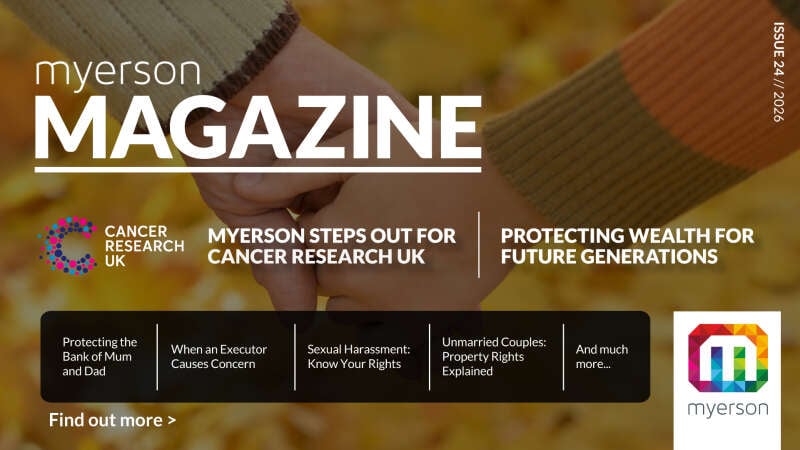
Myerson Magazine Autumn 2026 Issue
Welcome to the latest edition of Myerson Magazine, where we share practical legal advice, expert insights and news from across Myerson Solicitors. In this issue, we cover some of the important legal considerations that arise at different stages of life, from protecting family wealth and planning for the next generation to understanding your...
Read Newsletter
Myerson Solicitors Strengthens Chambers UK Rankings with Six New Recognitions in 2027 Guide
Leading independent law firm Myerson Solicitors has secured six new rankings in the Chambers and Partners UK Guide 2027, further strengthening its reputation for legal excellence and reflecting a sustained period of growth and success for the firm.
Read News
11
From Conflict to Collaboration with Marcie Shaoul
How can professionals better support separated parents to move away from conflict and towards a more constructive co-parenting relationship? The Myerson Family Law team is delighted to welcome Marcie Shaoul , founder of The Co-Parenting Method and one of the UK’s leading voices on constructive co-parenting following separation, for an engaging...
View Event
Do Grandparents Have Rights to See Their Grandchildren?
Grandparents often play a significant role in a child's life, providing emotional support and stability and, in some cases, being the child's primary caregiver. Official statistics published by the Office for National Statistics in 2021, together with more recent estimates from the Family Rights Group , suggest that around 160,000 children in...
Read Blog
Wedding Law Reform: Why the Proposed Changes Matter for Couples
The law governing weddings in England and Wales has remained largely rooted in legislation dating back to the nineteenth century. However, significant reforms may now be on the horizon. In July 2026, the government launched its consultation “ Tying the Knot: Reforming Weddings Law in England and Wales ”, proposing the most substantial overhaul...
Read Blog
The Remarriage Trap: What Every Divorced Person Should Know Before Saying “I Do” Again
For many, a second marriage is a true new beginning, a chance to improve with hindsight. Second marriages are far from uncommon. According to the Office for National Statistics (ONS) , around one in three opposite-sex marriages in England and Wales involve at least one person who has been married before. With thousands of divorced people...
Read Blog
Emily Arnold
Trainee Solicitor
Emily joined Myerson as a Trainee Solicitor in 2024. Emily studied Law at the University of Liverpool, graduating with a 2:1 in 2019.
About Emily Arnold