


Running a founder-led retail business in 2026 often means making high-stakes decisions with limited resources while navigating changing costs, shifting consumer demand, and rising regulatory pressure.
A solid grasp of core corporate law principles - such as governance, directors’ duties, fundraising, transactions, and ESG – can, however, help you move faster, with greater confidence and lower risk.
Below, our retail lawyers highlight the key topics we are currently discussing with founders and owner-managed retail teams, together with practical ways to safeguard the business without slowing its progress.
1. Corporate Governance: From Formality to Day-to-Day Decision Making
Corporate governance expectations have intensified across the retail sector.
Under the Companies Act 2006, directors must promote the success of the company for the benefit of its members as a whole, while having regard to wider stakeholders, including employees, suppliers, customers, and communities.
The key is showing that decisions were thought through and properly approved.
For example, decisions on store closures, restructuring, pricing, or supply chain realignment must be properly reasoned and documented, particularly where later scrutiny by shareholders, regulators, or insolvency practitioners is possible.
For founder-led and owner-managed businesses, governance is often less formal but no less important. The key risk is not usually the decision itself, but the absence of a clear process.
Even taking simple steps such as establishing clear delegated authority, obtaining appropriate approvals, and taking minutes of board decisions can significantly mitigate this risk.
Ongoing financial pressures continue to weigh on the UK retail sector in 2026.
Inflation, fixed rent costs, stock turnover and unpredictable consumer behaviour mean that cashflow can become tight very quickly. For founder‑led businesses, these challenges can be especially pronounced where decision‑making and financial oversight are not clearly defined.
Directors must be alert to how their duties evolve as financial distress develops.
When faced with financial distress, directors’ duties can start to shift towards protecting creditors. That’s the point where taking advice early really matters - because mistakes can increase personal risk for directors.

2. Transactions, Investment and Strategic Restructuring
For founder‑led retailers, “deals” are often practical growth or stabilisation steps rather than headline M&A.
These may include bringing in an investor, opening new sites, franchising or concessions, launching online with a strategic partner, or acquiring a smaller competitor’s assets or stock.
In other cases, the focus may be on protecting the business through lease renegotiations, restructuring key supplier arrangements or simplifying group structures.
These projects often move quickly, but the legal risk is frequently buried in the detail.
Issues such as ownership of IP and customer data, termination rights, employment liabilities, landlord consents and the scope of warranties can all have a material impact on value if not addressed early.
Clear heads of terms and focused due diligence are critical to identifying these risks upfront and avoiding costly surprises later.
Across all types of transactions, due diligence is becoming more detailed, with particular focus on supply chain resilience, property portfolios and lease obligations, digital infrastructure and data, and ESG and reputational risk.
For founders, the legal work should support the underlying commercial objective: preserving control of the brand, protecting cash and avoiding open‑ended liabilities.
Even where key decisions sit firmly with the founder, it is important to be clear on valuation, potential conflicts (including family or connected‑party arrangements), required approvals and communications with banks, landlords, suppliers and senior management.
Early alignment on these points can significantly reduce execution risk and delays.
In practice, the most effective transactions are underpinned by a clear understanding of what the business is trying to achieve, the key risks that could derail the deal and the commitments being given.
Taking the time to address these issues upfront helps protect value, reduce the risk of post‑deal disputes and ensure the transaction supports the retailer’s long‑term strategy.

3. Capital Structure and Ownership Dynamics
Founder‑led retailers often fund growth through a combination of reinvested profits, bank facilities, shareholder loans and, in some cases, a minority investor.
Getting the capital structure right at an early stage can protect founders personally and preserve flexibility for the next phase of the business, whether that involves opening new sites, expanding into new channels or planning for a future exit.
In owner‑managed businesses, difficulties frequently arise not because of legal complexity, but because expectations have never been clearly documented. Informal arrangements between family members, silent investors or key managers who later join the shareholding can become strained as the business grows or comes under pressure.
Common flashpoints include decision‑making authority, access to information and what happens if a shareholder wishes to exit or needs to be bought out.
Clear, well‑structured constitutional documents play a critical role in avoiding these issues.
Articles of association and shareholders’ agreements can set out, in plain English, who decides what, which matters require consent, how funding is structured and what protections apply on default. They can also address incentives for key staff, including option arrangements (such as EMI where appropriate) and clear good and bad leaver provisions.
Retailers of all sizes are increasingly reassessing capital structures in response to financing constraints and growth requirements.
Equity raises, shareholder loans, convertible instruments and group reorganisations are common tools, but they bring renewed focus on shareholder alignment and governance dynamics. Areas of potential tension include minority shareholder rights, consent thresholds for major decisions, exit mechanisms and family or connected‑party arrangements.
Well‑drafted shareholder agreements and governance frameworks help balance flexibility with control, reduce the risk of costly disputes and ensure the business is better positioned for fundraising, investment or a sale when the opportunity arises.

4. ESG Risk and Corporate Accountability
Environmental, social and governance (ESG) considerations are now a key source of corporate law risk.
As pressure on retailers to manage these risks increases, there is a growing expectation that claims relating to sustainability, ethical sourcing and workforce practices accurately reflect day‑to‑day operations.
A failure to do so not only heightens scrutiny from consumers, investors and shareholders, but may also expose companies to legal liability, litigation and, subject to legislative developments, regulatory enforcement.
For both large and small retailers, practical controls are therefore increasingly important. Internal due diligence, together with supply chain and operational audits, can help retailers identify ESG gaps at an early stage, assess whether public commitments align with actual practices, and take corrective action before issues escalate into legal or regulatory risk.
ESG governance is therefore shifting from a branding exercise to a structured legal and operational oversight.

A Practical Governance and Risk Checklist
Across founder-led retail businesses, the following disciplines consistently help to mitigate risk:
- Ensuring that key decisions are properly considered, documented, and approved
- Actively monitoring cash flow and identifying early signs of financial pressure
- Recognising when directors’ duties begin to shift towards creditors
- Putting clear, robust terms in place before entering into deals or partnerships
- Aligning shareholder expectations and clearly documenting ownership arrangements
- Managing ESG and marketing claims through clear, evidence-based processes
Conclusion
Whether a retail business is publicly listed or still founder‑led, governance, financial strength and stakeholder relationships now sit at the heart of day‑to‑day decision‑making.
Getting the basics right and involving legal advisers at an early stage isn’t just about avoiding problems. It can help businesses stay resilient, retain control as they grow, and protect long‑term value in an increasingly competitive retail landscape.

Contact Our Retail Lawyers
If you are navigating any of the issues outlined above, our retail lawyers work closely with founders and owner-managed businesses to provide clear, commercially focused advice at every stage of the business lifecycle.
Get in touch with our Retail Lawyers to discuss how we can support your business.
Latest Myerson Retail Law News

Can a Court Save a Retailer? The TG Jones Judgment Shows the Limits of Restructuring
On 1 July 2026, the High Court approved TG Jones' restructuring plan - but the judge (Mr Justice Hildyard) openly questioned whether the turnaround would succeed. Our Insolvency and Restructuring team explore what the Court’s decision in this case tells us about the current restructuring regime in England and Wales.
Read Blog
Retail and Hospitality: Growing your Local Business
Growing a retail or hospitality business presents exciting opportunities, but it also introduces new legal responsibilities. Whether you are expanding online, recruiting more employees or negotiating commercial premises, taking the right legal steps early can help protect your business and support sustainable growth. In this practical webinar...
Watch Webinar
What Due Diligence Is Required for a Commercial Property Purchase?
Purchasing a commercial property can deliver strong returns, whether through rental income received from tenants or long-term capital growth. It does, however, entail a range of legal and practical risks that, if not addressed and managed before exchange of contracts, can significantly affect the property’s value. Our Commercial Property team...
Read Blog
A Corporate Law Checklist for Founder-Led Retail Businesses in the UK
Running a founder-led retail business in 2026 often means making high-stakes decisions with limited resources while navigating changing costs, shifting consumer demand, and rising regulatory pressure. A solid grasp of core corporate law principles - such as governance, directors’ duties, fundraising, transactions, and ESG – can, however, help you...
Read Blog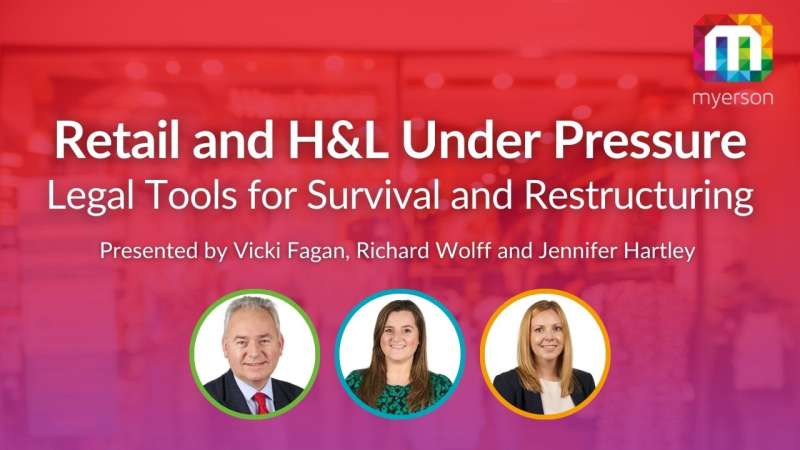
Retail and H&L Under Pressure: Legal Tools for Survival and Restructuring
Rising labour costs, increasing business rates, changing consumer behaviour and sustained inflation are placing significant pressure on the UK retail, hospitality and leisure sectors. In this practical and commercially focused webinar, our specialists in employment law , insolvency and restructuring , and property litigation examine the legal...
Watch Webinar
Commercial Lease Legal Updates 2026: What Retail Tenants Need to Know
As we approach the end of the second month of 2026, we look at some of the changes that retail tenants can expect during the remainder of this year and beyond. From major changes to rent review mechanisms to business rates reforms and stricter energy performance standards, these updates will all impact retailers. It is important to be aware of...
Read Blog
Alexia Dirgau
Trainee Solicitor
Alexia joined Myerson in 2022 as a Solicitor Apprentice and has been developing her legal knowledge and practical experience alongside her studies at BPP University. Her apprenticeship has provided her with a unique opportunity to learn through hands-on experience, working closely with colleagues across the firm while progressing towards qualification as a solicitor.
Alexia spent her first year in the Business Services team, where she gained valuable insight into how a law firm operates and developed a strong understanding of the importance of collaboration and client service. This experience provided an excellent foundation for her legal career and helped her build skills that she continues to apply in her work today.
Since then, Alexia has completed seats in Commercial Property, Commercial Litigation and Corporate, giving her exposure to a broad range of legal matters and allowing her to develop experience across both transactional and contentious work. These seats have helped her build a well-rounded understanding of the legal and commercial issues faced by individuals and businesses.
Alexia is currently undertaking a seat in the Probate Litigation team, assisting on a variety of contentious trusts and estates matters, including inheritance disputes and challenges relating to wills and estates. She particularly enjoys the variety of the work and the opportunity to help clients navigate what are often complex and sensitive situations.
One of the aspects Alexia enjoys most about her role is the collaborative nature of legal practice. She enjoys working closely with colleagues across different teams, drawing on a range of expertise to provide practical solutions for clients. Working alongside talented lawyers in a supportive environment has enabled her to develop both professionally and personally throughout her apprenticeship.
About Alexia Dirgau