
Make a Lasting Power of Attorney with Trusted Legal Experts
Why Should I Make a Lasting Power of Attorney?
Should you ever become unable to manage your financial affairs, property, or personal welfare decisions, a Lasting Power of Attorney allows you to appoint trusted individuals to act on your behalf, ensuring your best interests are protected and your affairs are handled with care and efficiency.
You must have the mental capacity to make an LPA when you make it. Capacity is decision-specific and is assessed at the relevant time.
By creating and registering your LPA in advance, you can have peace of mind knowing it will be ready to take effect if and when it is needed, protecting your future well-being and removing potential challenges for loved ones when managing your affairs.
Our expert solicitors will ensure the process is straightforward, giving you confidence in your decisions.

What Would a Lasting Power of Attorney Cover?
Health and Welfare LPA
Allows your attorney to make health and welfare decisions on your behalf, including decisions around personal care, where you live and what medical treatment you will or will not receive, if you lose capacity to make those decisions for yourself. You can also include provision for life-sustaining treatment within this LPA.
Property and Financial Affairs LPA
Covers property and financial affairs such as dealing with your bank accounts, investments and savings, living expenses, tax affairs and property .
It is possible to make just one type of LPA, although we generally recommend considering both so that appropriate arrangements are in place for both property and financial and health and welfare decisions.
Enduring Powers of Attorney (EPA)
EPAs were replaced by LPAs on 1st October 2007. It is not possible to make a new EPA, but existing EPAs validly executed before then may still be used. EPAs only need to be registered if the Attorneys have reason to believe that the Donor is losing mental capacity. We can assist with registering existing EPAs.
Specific or General Powers of Attorney
Tend to be more short-term documents, set up for a specific, fixed period (often a few weeks or months)) and often cover a specific transaction. These documents can only be used while the individual giving the power has mental capacity.

Our Lasting Power of Attorney Service
There are a number of steps to put a valid LPA in place. We can guide you through the process to help you draw up and register the documents which accurately reflect your wishes.
This includes:
- Helping you to understand the different types of powers that can be given
- Helping you choose the right attorney(s)
- Advising you on the best way to structure your LPAs
- Documenting issues which may affect the validity of LPAs such as mental capacity or undue influence
- Drafting your LPAs to include bespoke clauses to reflect your personal preferences
- Acting as a Certificate Provider, where appropriate, to confirm that you have understood what your LPA entails
- Witnessing your signatures, where you sign in our presence
- Helping your attorney(s) to execute their parts of the LPA to confirm that they are willing to act
- Registering your LPAs with the Office of the Public Guardian (OPG)
- Providing you with certified copies of the LPA should you need to use them in the future
- In some cases, we may need to liaise with your doctor or a medical professional to provide a mental capacity report

Our Lasting Power of Attorney Experience
Our experienced team frequently deal with LPAs and our Solicitors are trained in dealing with vulnerable people. Having undertaken additional training on the legalities of putting together LPAs as well as soft skills to deal with clients who may be losing mental capacity, our team are well equipped to help address and foresee practical issues which might arise later.
We are also members of Solicitors For The Elderly.
As well as making LPAs, we have also assisted attorneys in their role by providing advice on their role and duties.
Our team are highly ranked in The Legal 500 for personal tax, trusts and probate and in Chambers under the high-net-worth category as well as being under the high-net-worth category as well as winning Private Client Team of the Year – North of England at the Private Client Modern Law Awards 2026.


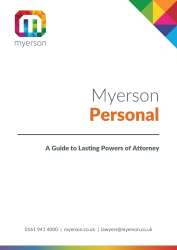

Choosing a Power of Attorney
Why Choose Myerson's Wills, Trusts, and Probate Team?
- Recognised Expertise: Our Private Client team is recognised as one of the UK's leading private wealth practices, securing two prestigious wins at the British Wills and Probate Awards 2026 for Probate Provider of the Year – North & Midlands and Tax & Trusts Team of the Year. The team also won Private Client Team of the Year – North of England and Private Client Trusts, Tax & Wealth Planning Team of the Year at the Private Client Modern Law Awards 2026, and was Highly Commended for Probate & Estate Administration Team of the Year. We also hold a Band 2 ranking in the Chambers High Net Worth Guide and have been recognised as a Top Tier firm by The Legal 500 for the past seven years.
- Qualified Professionals: Our team holds additional qualifications in trust administration and tax regimes for trusts, along with the prestigious STEP (Society of Trust and Estate Practitioners) qualification. We have extensive experience setting up and managing live trusts, ensuring we understand the practicalities of trust operation and drafting.
- Comprehensive Support: We provide tailored advice that respects each client's unique circumstances and understands the emotional weight of estate matters. Our solicitors handle sensitive situations with care, offering support throughout the process.
- Holistic Approach: Our holistic strategy allows us to identify tax-saving opportunities and mitigate unexpected liabilities. We ensure clients comprehend the purpose and functioning of trusts, providing city-quality advice at regional prices.
- Partner-Led Service: Our partner-led approach guarantees the best legal advice and commercially minded support. We collaborate with corporate, family and property law teams, delivering a comprehensive service that addresses all aspects of estate management.
- Specialist Expertise: Our highly ranked team in The Legal 500 and Chambers for personal tax, trusts, and probate works closely with our contested wills solicitors to provide expert advice tailored to your needs.
- Recognised Leaders: Bik-ki Wong, Head of our Private Client team, has been recognised as one of the top influential private wealth lawyers in Manchester (2023) by Business Today and as one of the best probate and wills lawyers for high-net-worth individuals in the UK (2023) by Spear's.
- Extensive Network: Through our UK200 Group membership, we have strong connections to Independent Financial Advisers (IFAs) and tax advisers, offering comprehensive support tailored to your specific requirements.
- Catering to Diverse Needs: Our team includes Cantonese speakers, ensuring effective communication and understanding in managing estates.
- With our MSI Global Alliance Membership, we can connect you to trusted advisers in 100+ countries who can provide international legal advice for individuals and families.
- Look at the Myerson Promise for further benefits of working with us here.
LPA FAQS
What is a Lasting Power of Attorney (LPA)?
An LPA is a legal document where a person (the Donor) appoints a person or persons (the Attorneys) to assist with decision-making during their lifetime. The Donor must have mental capacity to grant an LPA at the time of making it.
Why types of Powers of Attorney are there?
For LPAs there is one to cover property and financial affairs such as dealing with your house and bank accounts and another one to cover health and welfare decisions which includes where you live and what medical treatment you will or will not receive. You can make just one type, but most people tend to make both at the same time.
There are other types of Powers of Attorney as well. Enduring Powers of Attorney (EPA) which can no longer be made and were replaced by LPAs on 1st October 2007 but they can still be used if validly executed; Specific or General Powers of Attorney tend to be more short-term documents () and require the Donor to retain mental capacity at the time of use.
What is the difference between an Enduring and Lasting Power of Attorney?
Enduring Powers of Attorney (EPA) were replaced by LPAs on 1st October 2007 but they can still be used if validly executed prior to this date. EPAs only deal with the property and financial affairs of the Donor, whereas LPAs can be for both property, financial affairs and health and welfare.
If you have an EPA and are happy with whom you have appointed but would like to appoint attorneys to deal with your health and welfare, you can make an LPA to cover just your health and welfare decisions.
The other main difference is that an LPA must be registered for it to be valid but EPAs only need to be registered if the Attorneys have reason to believe that the Donor is losing mental capacity and is unable to manage their financial affairs on a day-to-day basis.
Do I need a solicitor to make Power of Attorney?
Technically you do not need a solicitor to make an LPA however, we would strongly advise that you seek guidance on the best way to structure your LPAs.
There have been many incidents where the wrong person has been appointed and there has been financial abuse which has required intervention by solicitors of the court which is costly or the wrong type of authority given, which has caused problems as the LPA cannot be used in some circumstances.
The Office of the Public Guardian is also very strict on the signing of LPAs and therefore it is possible for them to be rejected on multiple occasions which can be problematic if the Donor then loses mental capacity prior to the documents being validly executed and registered.
Do I need a Will if I have an LPA?
LPAs only deal with decision-making whilst the Donor is alive and incapable of making decisions themselves (unless their LPA for property and financial affairs permits their attorney to act whilst they retain capacity, with their consent).
Once the Donor dies, the power comes to an end, and the personal representatives of the estate will take over the administration of the estate. If you do not have a Will, the rules of intestacy will apply so you may have family members whom you do not wish to deal with your estate in charge of your assets whereas making a Will allows you to appoint your preferred executor.
What happens if I don’t have an LPA?
If a person loses mental capacity and has not put into place a valid LPA, someone will need to make an application to the Court of Protection for a Deputyship Order. A Deputy is similar to the role of the Attorney but the appointment will need to be made by the Court of Protection.
This means that they will need full disclosure of the person’s finances, including income, expenditure and current assets. They will also need to complete checks on the intended Deputy.
The Court of Protection may limit who they will appoint as Deputy. Under an LPA, more than one can be appointed and in different ways to suit the Donor. An application for a Deputyship Order can take a considerable amount of time, often in excess of 9 months and can be costly (often at least 3 times the cost of making an LPA).
Who should I appoint as an attorney under my lasting power of attorney?
Acting as an attorney is a big responsibility, and the attorney needs to be capable of doing the job.
An attorney under an LPA for Property may need to access and manage your finances.
An attorney under an LPA for Health and Welfare may need to make decisions around personal care and treatment.
Your attorneys therefore need to be people that you can trust.
They do not need any special qualifications as they can and should seek professional advice when it comes to investing or managing assets.
Most people will appoint family members as their attorneys, but you can appoint friends, colleagues, or a professional.
We will discuss the decision of who to appoint in detail with the client.
What decisions cannot be made by a legal power of attorney?
Attorneys must act within the authority granted by the LPA. Where the donor lacks capacity, their attorney must act in accordance with the Mental Capacity Act 2005 and in the donor’s best interests.
There are restrictions on certain decisions. For example, an attorney acting under an LPA for Property and Financial Affairs only has very limited authority to make gifts on the donor’s behalf. Gifts outside of that authority may require approval from the Court of Protection.
An attorney also cannot make a Will for the donor.
These decisions, and other similar matters, may need input from the court.
How much does a lasting power of attorney cost?
We charge fixed fees for LPAs. Please see our guide for details.
Can I still make an LPA if I have had a recent diagnosis of dementia?
An individual must have the necessary mental capacity to make an LPA.
A dementia diagnosis in itself does not necessarily mean someone lacks the mental capacity to make LPAs.
It may still be possible to make an LPA in these circumstances.
The solicitor acting for you may recommend additional safeguards and a formal mental capacity assessment may be required.
Read more in our guide to can you make lasting powers of attorney after being diagnosed with dementia.
What is the Powers of Attorney Act 2023?
The Powers of Attorney Act 2023 provides the framework for modernising the LPA process, including greater use of digital processes and additional safeguards.
It aims to make the process faster, more accessible and more secure. The aim is to :
- speed up registration time by picking up errors earlier and allow these to be fixed online
- allow checks on the identity of those applying for an LPA, to prevent fraud
- allow for an LPA to be made digitally
- widen the group of people who can make an objection
- expedite the objection process
The changes follow a perceived need to update and streamline the service after a significant increase in LPA applications in recent years. Not all of the reforms provided for by the Act are yet in force and the existing LPA process continues to apply, pending the implementation of those provisions.
Testimonials

Legal 500, 2027
The lead partner, Bik-ki-Wong, is able to understand complex situations quickly and devise practical solutions.

Mr Staples
Outstanding service from Aalia Ijaz and her team. I would recommend Myerson 100%.
Mr. Fox
Ben kept me informed at all times. He dealt with my case in a quick and professional manner.
Mr. A
I dealt with Hannah Owens and she was extremely helpful and professional. As a result, I would have no hesitation in recommending your firm to my friends if they required legal advice.
Mrs & Mr Brighouse
Hannah Owens really understood our requirements. She explained various options, including the use of trusts, and had a deep understanding of the issues & tax legislation. She was very easy to talk to.
Mrs & Mr Wells
Laura Willis was very professional and dedicated a great deal of time to preparing our wills. Overall, we felt we were truly getting our money’s worth.
Legal 500, 2027
Excellent teamwork and very professional.
Legal 500, 2027
Laura Willis - Laura is an absolute credit to her profession. I have worked with Laura for over ten years, and she has a wonderful ability to explain complex legal matters to clients.
Legal 500, 2027
Clare Staunton is the main person I've dealt with, and she's been great with the client work we've done together.
Legal 500, 2027
Great client service and clear quality.
Legal 500, 2027
Ben Murphy has been my contact throughout, and he has been brilliant.
Mr Lee
Ever since appointing Myerson, I have received the best of advice and action on matters of great concern to my family.
Mr Barker
Having dealt with many lawyers over the years, it was refreshing to find Myerson who were professional, prompt, courteous, along with going the extra mile for their clients. Very impressive. Thank you.
Mr Gough
Great staff and all conducted in an informative and constructive way. Nice new office which created the right atmosphere for my visits.
Mr. Frame
Myerson were extremely helpful in liaising with me to submit an application to the Court of Protection. The solicitor was very knowledgeable and efficient in obtaining the required information and processing the paperwork in a timely manner. I am delighted with the standard of the work.
Legal 500, 2024
Approachable, knowledgeable and competent.
Heather
Laura undertook to complete the distribution of my husband's will since my previous solicitor was unable to do it. A difficulty had arisen from the way the Inheritance Tax had been paid and Laura explained that I could solve my problem with a Deed of Assignment. I was happy to let her prepare this for me
Peter
Our business was dealt with by Bik-ki Wong who impressed us with her competency and efficiency, whilst remaining friendly and helpful at all times. Our queries were answered clearly and promptly giving us confidence that our business would be carried out to our complete satisfaction
Anonymous
Myerson have been our solicitors for several years. They have guided my husband and I in arranging making wills, lasting power of attorney and initially, after the death of my husband through the process of probate.
Mrs. Westwood
Compared to my original solicitors Myerson have been excellent. Hannah Owens has provided clear explanations of the various options available to us, timely responses, and has been upfront about the expected costs.
Mr P
Handled our personal wills very professionally. Really clear and “no-nonsense” approach which we really appreciated
Ruth
I contacted Myerson as I was unable to find a solicitor in Ireland to deal with UK probate for my father's estate as there was a possible complication with domicile. Clara Staunton initially, then Hannah Owens were friendly, helpful, efficient, and proactive in dealing with the case, kept us informed all through the process, followed up without prompting from us and indeed prompted us when needed. It was a pleasure to deal with Hannah and Clara, and I would have no hesitation in recommending them.
Peter Brett & Elizabeth Brett
The service that Myerson provided was excellent. All aspects and options regarding my Will were discussed and explained to our understanding. Based on our experience we would not hesitate to recommend your Company to friends and family.
Legal 500, 2024
They go the extra mile to help their clients.
Anonymous
Laura Willis and Bik-ki Wong have been a credit in resolving my issue and ensured the process was both timely and transparent. Thank you!
Susan
I cannot recommend this firm highly enough. During a very difficult time after the death of my husband, we were treated with the utmost sensitivity and compassion. Hannah at Myerson, in particular, supported my family extremely efficiently throughout the whole process of probate. Communication was frequent and nothing was too much trouble.
Joyce Mann
Clara was very efficient in dealing with my late husband’s Will. Clara was always available to help in any way. Very caring and understanding, that is very important to clients. I must mention your reception team were always happy to help.
Anonymous
I was very impressed with the care and attention that was given to me by Clara Staunton. She went through everything with me and everything was completed in a very short time even though she had to get things signed by one of my sons who lives in New Zealand. I would recommend your firm to anyone who needed a good reliable solicitor. Once again, thank you for everything.
Mr. Wallace
Excellent proactive support to myself and my business led by Clara Staunton and Charlotte Peers who were both excellent every step of the way.
Phil
Handled our personal wills very professionally, really clear and “no-nonsense” approach which we really appreciated
Legal 500, 2024
The team at Myersons continue to provide excellent support to this Family Office. They are diligent professionals always on hand with expert advice delivered in a friendly and meaningful way.
Legal 500, 2024
Very experienced and highly skilled team. Very good to work with on those matters where collaborative working required.
Mr. Lee
Everything that you have touched in what has been a difficult time for me has been dealt with promptly and in the knowledge that I am not at my best. I value the care you have shown.
Meet Our Wills, Trusts, and Probate Lawyers
Home-grown or recruited from national, regional or City firms. Our wills, trusts, and probate lawyers are experts in their fields and respected by their peers.
Darren Christopherson-Smith
Darren is a Solicitor in our Wills, Trusts and Probate Team
Contact Our Experts
You can contact our lawyers below if you have any more questions or want more information:
0161 941 4000
Latest Myerson Wills, Trusts, and Probate News

Do You Need to Make a Will When You Have a Baby?
The arrival of a new baby into your family is a significant milestone that gives rise to with new responsibilities and considerations. You are responsible for caring for and raising your child as they grow and develop each day. Whilst it can be difficult to think about, you should also ensure that you have made appropriate arrangements for your...
Read Blog
Myerson Solicitors Celebrates Double Win At British Wills and Probate Awards 2026
We are delighted to announce that we have secured two national accolades at the British Wills and Probate Awards 2026 , recognising the strength and expertise of our Private Client team. As a Top 200 UK law firm, we were proud to take home two prestigious awards at the national ceremony held on Thursday, 8th October: Probate Provider of the Year...
Read News
Solicitor Closed Down? What Happens to Your Will and How to Find It
Has the firm that drafted your Will closed down? Don’t panic! There are still ways to locate and obtain your Will. Our Wills Lawyers explain what may happen to your Will and other original documents in this situation.
Read Blog
4
Planning for the Future: Succession in Farming and Rural Businesses
Practical succession planning for farming families, covering business structures, Wills, trusts, land and protecting the future of the farm. Succession in farming is about much more than passing on land. It involves protecting the future of the family, the farming business and the assets that have often been built up over generations.
View Event
Cohabiting Couples and Inheritance: Could the Intestacy Rules Be About to Change?
The Ministry of Justice has opened a public consultation, ‘ A Fairer End to Relationships ’ , which aims to strengthen the legal rights of cohabitees within the England and Wales. Cohabiting couple families in England and Wales now account for 17.6% of all families , yet the current law still treats married and unmarried couples very differently...
Read Blog
Myerson Magazine Summer 2026 Issue
We're pleased to share the latest issue of Myerson Magazine, bringing together practical legal insights, updates on significant legislative changes and stories from across the firm. In this Summer edition, our experts explore the legal issues affecting individuals, families, business owners and property investors, from the Renters' Rights Act and...
Read Newsletter