


However, for hospitality and leisure employers, the Christmas period also brings with it a heightened risk of employees experiencing sexual harassment, especially with alcohol consumption, Christmas parties, staff celebrations and more relaxed social boundaries that typically arise during December trading.
Our Hospitality and Leisure Lawyers explore what the new duty to prevent sexual harassment means in practice, particularly during the Christmas season when risks are heightened.
What are the current POSH obligations for an employer?
This is a proactive duty that requires employers to consider and manage the risk of workplace harassment before incidents occur.
This becomes particularly important during the Christmas season, when employers often host festive events, late-night functions, and staff parties, all of which increase the likelihood of inappropriate behaviour.
The Equality and Human Rights Commission (‘EHRC’) guidance provides eight practical steps that employers should take to prevent and deal with sexual harassment in the workplace:
- Develop an effective anti-harassment policy;
- Engage staff;
- Assess and take steps to reduce risks;
- Set up a reporting system;
- Conduct training;
- Handling any complaints appropriately;
- Dealing with third-party harassment;
- Monitor and evaluate actions.

- Tribunal claims with uplifted compensation (up to 25%);
- Investigation or enforcement notices by the EHRC; and
- Reputational damage, especially on social media or employer review sites - a risk that tends to rise during the Christmas season when incidents are more public-facing.
Third-party harassment
In light of this, the EHRC has also explained in its technical guidance that the preventative duty includes an obligation on employers to prevent sexual harassment by third parties.
Hospitality and leisure employees are especially exposed to harassment from customers, contractors or suppliers, in light of late-night working and the consumption of alcohol, particularly during the Christmas period.
As a result, employers in this industry are expected to take reasonable steps to prevent and respond to third-party harassment, too.
Although at present, employees cannot bring a stand-alone tribunal claim against their employer for third-party harassment, the potential consequences of an employer breaching their preventative duty in this regard are:
- The EHRC could take enforcement action against the employer. This action could include issuing an unlawful act notice; requesting an injunction against the employer from a court; or entering into a formal, legally binding agreement to prevent future unlawful acts.
- The employee may be able to bring other claims, such as direct or indirect discrimination or constructive unfair dismissal, with the Tribunal having the ability to uplift compensation (as above).

What changes to the preventative duty are being introduced by the Employment Rights Bill (‘ERB’)?
Employers will also be under a duty to take “all reasonable steps” to prevent third-party harassment in relation to all relevant protected characteristics (such as age, disability, gender reassignment, marriage and civil partnership, pregnancy and maternity, race, religion or belief, sex and sexual orientation).
The government will have the power to specify, by regulation, what will be regarded as the reasonable steps an employer should take, or has failed to take, to prevent sexual harassment.
The duty proposed by the ERB to take all reasonable steps to prevent sexual harassment of employees, including by third parties, is undoubtedly more onerous.
It will be much harder to successfully defend a sexual harassment claim, and employers will face both the financial penalty of an uplift to the employee’s compensation and a potential investigation by the EHRC, resulting in enforcement action.
Employers should therefore consider the above-mentioned eight steps published by the EHRC in greater detail ahead of the ERB implementation, particularly as festive-season incidents often form the basis of complaints raised in the new year.

What should employers be doing in the meantime, particularly during the festive period?
- Encouraging employees to report any incidents of third-party harassment and being clear on how they can do this;
- Displaying zero-tolerance signage;
- Training staff on de-escalating situations; and
- Banning customers or reporting offenders to the police or to their employers, as applicable.

Watch: Understanding Employers’ Responsibilities to Prevent Workplace Sexual Harassment
Contact Our Hospitality and Leisure Team
0161 941 4000
Latest Myerson Hospitality and Leisure News

Retail and Hospitality: Growing your Local Business
Growing a retail or hospitality business presents exciting opportunities, but it also introduces new legal responsibilities. Whether you are expanding online, recruiting more employees or negotiating commercial premises, taking the right legal steps early can help protect your business and support sustainable growth. In this practical webinar...
Watch Webinar
What Due Diligence Is Required for a Commercial Property Purchase?
Purchasing a commercial property can deliver strong returns, whether through rental income received from tenants or long-term capital growth. It does, however, entail a range of legal and practical risks that, if not addressed and managed before exchange of contracts, can significantly affect the property’s value. Our Commercial Property team...
Read Blog
Structuring Gyms and Sports Clubs: Company, CIC or Charity?
Choosing the appropriate legal structure is an important decision for any gym or sports club. The structure determines how the club can hold its assets, enter into contracts, employ staff and raise funding. While many clubs may start informally or as unincorporated associations, growth in membership, income, or facilities often makes an early...
Read Blog
National Minimum Wage Increase - The Impact on Hospitality and Leisure
As we approach April 2026, businesses across the hospitality and leisure sector should be braced for another significant rise in the National Minimum Wage (“NMW”) and National Living Wage (“NLW”). Although annual increases are not new, the scale of recent changes combined with wider cost pressures means that this year’s adjustments warrant...
Read Blog
Myerson Celebrates Successful ‘A Taste of Altrincham’ Festival as Headline Sponsor for Second Year
Myerson is celebrating the success of this year’s 'A Taste of Altrincham', having returned as headline sponsor for the second consecutive year. The 10-day festival, which ended on 8th March 2026, brought together residents, visitors and local businesses to celebrate Altrincham’s thriving food and drink scene. A diverse programme of events...
Read News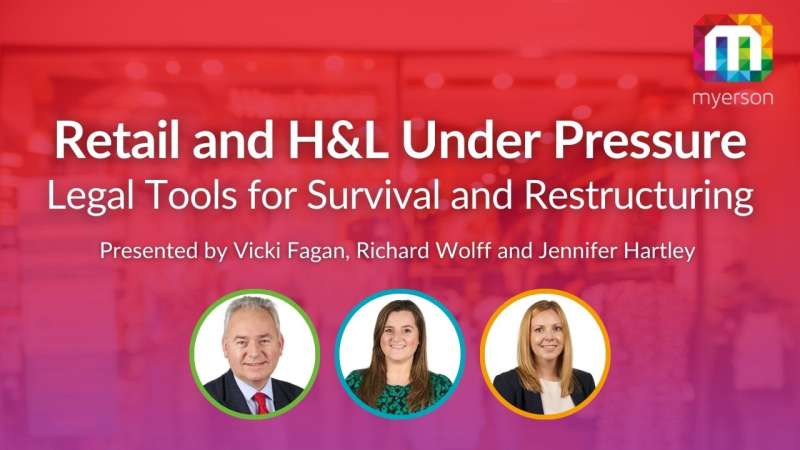
Retail and H&L Under Pressure: Legal Tools for Survival and Restructuring
Rising labour costs, increasing business rates, changing consumer behaviour and sustained inflation are placing significant pressure on the UK retail, hospitality and leisure sectors. In this practical and commercially focused webinar, our specialists in employment law , insolvency and restructuring , and property litigation examine the legal...
Watch Webinar
James Banks
Trainee Solicitor
James joined as a Trainee Solicitor at Myerson in 2024. Prior to joining the firm, James graduated from Durham University with a First Class Honours LLB. He is currently completing the SQE qualification with BPP University in Manchester.
About James Banks