


Our Retail Lawyers emphasise the critical importance of directors in the retail sector proactively managing financial distress and seeking early expert advice to minimise personal liability, particularly concerning wrongful trading and evolving insolvency duties.
The Increasing Pressure on Retail Directors
In recent years, the UK retail industry has been the subject of several high-profile insolvencies including The Body Shop, Ted Baker and Homebase which demonstrate that the financial impact of rising commercial rents, cautious consumer spending, higher employment costs following changes in employer’s national insurance contributions and the national living wage are not solely isolated to smaller retail businesses.
When a company faces financial distress, directors can face significant personal risks, including personal liability for company debts, particularly if they have given personal guarantees or engaged in wrongful trading.
Other potential risks include claims for misfeasance (if a director misuses company assets or engages in improper conduct), breach of fiduciary duty and penalties for failing to meet tax obligations to HMRC.
Understanding a Director’s Legal Duties in Insolvency
In ordinary circumstances, directors owe certain statutory duties to the company.
These are set out in the Companies Act 2006 and include:
- The duty to act within their powers;
- The duty to promote the company’s success;
- Exercising independent judgment;
- Avoiding conflicts of interest; and
- Exercising reasonable care, skill and diligence.
When a company experiences financial distress to the extent that insolvency is likely, directors' duties shift from being owed to the company (in effect, the company’s shareholders) to being owed to the company’s creditors.
This is known as the ‘creditor duty’ and was confirmed in the UK Supreme Court decision of BTI 2014 LLC v Sequana SA and others which held that the point at which the directors’ obligations shift to being owed to creditors is the point at which the directors knew or ought to have known that the company was insolvent or likely to be insolvent.
In essence, as a company’s financial position deteriorates and insolvency is increasingly likely, the ‘creditor duty’ requires that directors of a company consider and give appropriate weight to the interests of the company’s creditors.
The nature of the creditor’s duty and the extent to which it overrides any conflicting interest of shareholders will depend upon the extent of the company’s financial difficulties.

What is Wrongful Trading?
Wrongful trading occurs when the directors of a company, knowing or having reasonable grounds to believe the company is insolvent, continue to trade, incurring further debts, and ultimately leading to a formal insolvency process, such as liquidation.
In such cases, directors can be held personally liable for the losses to creditors caused by their actions.
Only directors can be liable for wrongful trading, but the definition of “director” is widely drawn in the Insolvency Act 1986 (IA 1986). It includes individuals who are not only de jure directors (those legally appointed as a director of a company and whose appointment is properly registered at Companies House) but also those who act as a director without formal appointment (de facto directors) and individuals who heavily influence company decision-making but without formal appointment (shadow directors).
As a result, individuals who could be considered de facto directors or shadow directors should also consider the consequences of wrongful trading as the company approaches insolvency.

The key elements to prove wrongful trading are:
- Insolvency. Establishing that the company was insolvent, meaning that it couldn’t pay its debts as they fell due or that its liabilities exceeded its assets.
- Tipping point. Identifying the specific point in time when a director knew, or ought to have known, that the company was heading towards insolvency and would likely enter liquidation.
- Lack of skill and knowledge. Demonstrating that a reasonable director with the same skills and experience would have realised the company was in financial distress and taken steps to mitigate losses.
- Failure to minimise losses. Showing that the directors failed to take every step possible to minimise potential losses to creditors after the tipping point.
- Financial loss. Proving that the company’s creditors suffered a loss as a result of the directors’ actions (or inaction) after the tipping point.
The most high-profile example of wrongful trading in a retail context occurred following British Home Stores (BHS) entering liquidation in 2018.
In the BHS case, the court held that the directors of BHS knew or ought to have known that insolvency was unavoidable at several points before BHS went into liquidation.
The BHS case demonstrated the difficulties in establishing the tipping point at which insolvency is unavoidable under the wrongful trading provisions under IA 1986 as the court held that there were six distinct points at which the directors should have known that insolvency was inevitable.
However, the court ultimately decided that the relevant tipping point was the last date on which the BHS directors should have known that insolvency was unavoidable but continued to trade. The court ultimately found two former directors of BHS liable for wrongful trading.
Personal Liability Risks for Directors
A finding of wrongful trading can lead to a director being held personally liable for company debts and/or facing director disqualification proceedings.
Therefore, directors must seek urgent professional advice when experiencing financial distress.
The BHS wrongful trading case also demonstrated that the proportion of personal liability for directors may vary based on differences in “involvement and culpability” among the directors.
This meant that the directors who were held to have greater involvement and were more responsible for the losses suffered were ordered to pay a higher proportion of the total liability.
Furthermore, directors may also face personal liability if they have granted personal guarantees for the company's debts.
If the company then defaults on debts subject to a personal guarantee, the lender can seek to enforce the debt against the director personally.
Directors will also be personally liable to repay any overdrawn directors' loan accounts once a company has entered a formal insolvency process, such as liquidation.

Practical Steps to Minimise Risk
When a retail business experiences financial distress, it is essential to:
- Seek urgent professional advice from both an insolvency practitioner and an insolvency lawyer, particularly in relation to possible formal insolvency procedures such as administration or liquidation;
- Ensure all decisions taken by the directors of the company are properly documented;
- Ensure all communications with creditors are in writing; and
- Avoid reviewable transactions, such as preferences or transactions at an undervalue, which can be actions carried out by the company’s directors in order to ease the company’s day-to-day problems.
The importance of seeking and following professional advice is demonstrated by the BHS wrongful trading case where the directors of the company were ordered to pay over £100 million (although this was in relation to both the wrongful trading and trading misfeasance claims).

The Importance of Independent Legal Advice
When a company is in financial distress, it is important that the directors of the company have separate legal representation because it will help them to understand their duties and personal liabilities, navigate the complexities of insolvency law and protect themselves from personal claims.
Proactive legal advice offers significant advantages over reactive litigation defence when dealing with company insolvency.
Early intervention can minimise losses, reduce costs associated with legal battles and potentially prevent the need for formal insolvency proceedings altogether.
This approach allows for strategic planning, negotiation and restructuring, potentially saving the company and its stakeholders from the harsh realities of a formal insolvency process, such as administration or liquidation.



Contact Our Insolvency and Retail Lawyers
Myerson’s Insolvency and Restructuring team have significant experience in advising directors in the retail sector. We provide confidential consultations and bespoke legal protection strategies.
We also have excellent working relationships with many national, regional and local independent insolvency practitioners who can be called upon to provide their advice and input as and when required.
0161 941 4000
Latest Myerson Retail Law News

Can a Court Save a Retailer? The TG Jones Judgment Shows the Limits of Restructuring
On 1 July 2026, the High Court approved TG Jones' restructuring plan - but the judge (Mr Justice Hildyard) openly questioned whether the turnaround would succeed. Our Insolvency and Restructuring team explore what the Court’s decision in this case tells us about the current restructuring regime in England and Wales.
Read Blog
Retail and Hospitality: Growing your Local Business
Growing a retail or hospitality business presents exciting opportunities, but it also introduces new legal responsibilities. Whether you are expanding online, recruiting more employees or negotiating commercial premises, taking the right legal steps early can help protect your business and support sustainable growth. In this practical webinar...
Watch Webinar
What Due Diligence Is Required for a Commercial Property Purchase?
Purchasing a commercial property can deliver strong returns, whether through rental income received from tenants or long-term capital growth. It does, however, entail a range of legal and practical risks that, if not addressed and managed before exchange of contracts, can significantly affect the property’s value. Our Commercial Property team...
Read Blog
A Corporate Law Checklist for Founder-Led Retail Businesses in the UK
Running a founder-led retail business in 2026 often means making high-stakes decisions with limited resources while navigating changing costs, shifting consumer demand, and rising regulatory pressure. A solid grasp of core corporate law principles - such as governance, directors’ duties, fundraising, transactions, and ESG – can, however, help you...
Read Blog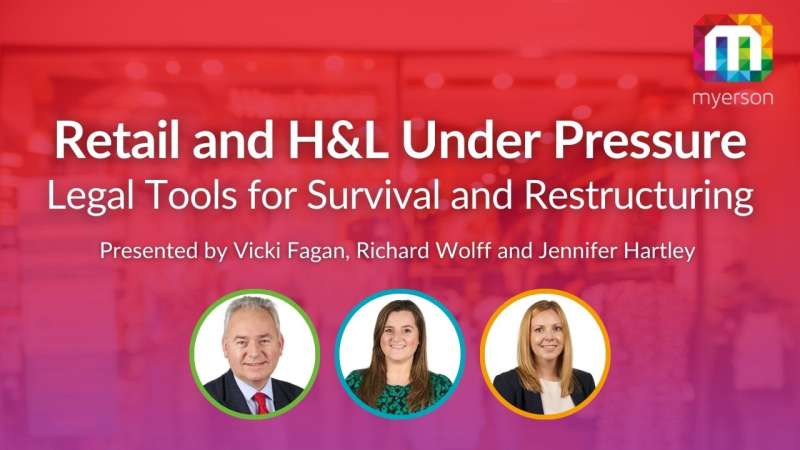
Retail and H&L Under Pressure: Legal Tools for Survival and Restructuring
Rising labour costs, increasing business rates, changing consumer behaviour and sustained inflation are placing significant pressure on the UK retail, hospitality and leisure sectors. In this practical and commercially focused webinar, our specialists in employment law , insolvency and restructuring , and property litigation examine the legal...
Watch Webinar
Commercial Lease Legal Updates 2026: What Retail Tenants Need to Know
As we approach the end of the second month of 2026, we look at some of the changes that retail tenants can expect during the remainder of this year and beyond. From major changes to rent review mechanisms to business rates reforms and stricter energy performance standards, these updates will all impact retailers. It is important to be aware of...
Read Blog
Vicky Biggs
Legal Director
Vicky is a Legal Director in the Insolvency and Restructuring team at Myerson and has been with the firm since 2012. Utilising her commercial litigation experience, Vicky now specialises in contentious insolvency matters, advising insolvency practitioners, directors and individuals in relation to both corporate and personal insolvency issues.
Vicky advises on a wide range of insolvency matters, including claims made by administrators, liquidators and trustees in bankruptcy, director disqualification proceedings, remuneration approval applications, retention of title claims, validation orders, bankruptcy annulment applications and winding-up and bankruptcy petitions.
About Vicky Biggs