


On 21 August 2025, the Equality and Human Rights Commission (EHRC) announced that Lidl GB had entered into a legally binding agreement to tighten its protections against sexual harassment in the workplace.
This followed an employment tribunal’s finding that between 2019 and 2021, Lidl failed to take all reasonable steps to protect a young female employee from sexual harassment by a colleague. The tribunal heard that managers at the store were unaware of the company’s own anti-harassment policy, no risk assessments had been carried out, and the business relied on employees to raise complaints before taking any action.
This case, and the EHRC’s decisive enforcement action, come at a time when the legal landscape has shifted.
Since October 2024, the law has imposed obligations on all employers to prevent sexual harassment in the workplace.
This is a proactive duty that requires all employers to develop an effective anti-harassment policy, engage with and train staff, assess risks, implement measures to prevent sexual harassment, and establish systems to monitor those measures and address any issues that may arise.
Our Employment Lawyers explore what the Lidl case means for employers and how businesses can meet their legal obligations to prevent workplace sexual harassment
What is sexual harassment?
The Equality Act 2010 defines sexual harassment as unwanted conduct of a sexual nature which has the purpose or effect of violating someone's dignity or creating an intimidating, hostile, degrading, humiliating or offensive environment for them.
This can be a one-off incident and can include making remarks about someone’s body, clothing or appearance, telling sexually offensive jokes, asking about someone’s private life or touching someone against their will.
Employers who fail to meet the duty to prevent sexual harassment face serious financial and reputational risks.
If an employee wins a sexual harassment claim in the Employment Tribunal and the employer is found to have failed to take reasonable steps to prevent it, any compensation awarded may be uplifted by 25%.
With no cap on compensation for sexual harassment claims, such an uplift could be particularly damaging.
Additionally, the Equality and Human Rights Commission (the ‘EHRC’) has the power to investigate businesses – even without an incident of sexual harassment taking place or a tribunal claim being brought - and enforce compliance, including entering into a formal, legally binding agreement with the employer to prevent future unlawful acts.

What happened in the case of Hunter v Lidl GB?
Miss Hunter, a young female, was employed by Lidl as a Customer Assistant between February 2019 and July 2021.
Soon after joining the company, a male colleague moved to the till next to hers, asked her for her number and made repeated sexual advances towards her. Miss Hunter asked to change to another till, but she was told that this was not possible and that she should take the advances as a compliment.
As her employment continued, she was subjected to inappropriate and unwelcome behaviour from the deputy store manager, including sexualised comments and physical touching.
While Miss Hunter did not raise a formal grievance regarding harassment, she did complain to her line manager and also requested to be placed on different shifts to the deputy store manager.
Miss Hunter’s complaints were largely ignored, and she claimed that he store manager laughed and said he was not surprised by his colleague’s alleged behaviour.
Miss Hunter asked to be transferred to a store with a female manager, but she was told that that was not one nearby.
Following her resignation, Miss Hunter brought a claim for sexual harassment, as well as a number of other employment-related claims.

The tribunal found Miss Hunter had been subjected to sexual harassment in the workplace. In reaching its conclusion, the tribunal recognised that she had been reluctant to make a formal complaint at the time because it was her first job and she was in a junior role.
The tribunal noted that it was surprising that Miss Hunter’s line manager did not further investigate why she did not want to be on the same shift as the deputy store manager and found that her line manager should have been alert to the possibility of harassment.
Additionally, it was found that the store managers were unaware of Lidl’s own anti-harassment policy; no sexual harassment risk assessments had been conducted; there was no evidence of staff training on equality and harassment; and the company relied solely on employees raising complaints before taking action.
Lidl was subsequently ordered to pay Miss Hunter over £50,000 in compensation.
What happened following this case?
While the case was heard prior to the preventative duty being imposed in October 2024, following the tribunal judgment, Lidl has provided training to the managers concerned and introduced further bullying and harassment training for broader rollout across the business. Lidl also consulted with the EHRC in relation to some further action, including completing a sexual harassment risk assessment.
The EHRC has recently announced that Lidl has also signed a legally binding agreement to further improve its prevention of sexual harassment in the workplace.

In the agreement, Lidl has committed to:
- Run a staff survey relating to sexual harassment within the workplace to assess if additional preventative steps are necessary;
- Develop a system to monitor and analyse informal complaints of sexual harassment to identify ongoing risks and whether additional preventative steps are required;
- Monitor the effectiveness of complaint handling for new formal complaints of sexual harassment;
- Review a sample of sexual harassment complaints from 2023 and 2024 to assess any trends and risks;
- Arrange meetings with its existing diversity, equality and inclusion groups to discuss risks of sexual harassment, and any additional preventative steps which could be taken;
- Continue to monitor and review its sexual harassment risk assessment;
- Further review internal harassment policies and training content, including its relationships at work guidance.
What should employers be doing now?
The case should serve as a warning – all employers have a legal duty to prevent sexual harassment and they must be able to prove they’ve taken reasonable steps to do so. EHRC’s involvement in this matter, and others, is demonstrative of their intention to continue to hold employers to account and use its enforcement powers where necessary.
Complying with the duty to prevent sexual harassment is not a one-off exercise.
Employers must continue to monitor, evaluate, and train staff to identify inappropriate behaviour, respond effectively to complaints, and foster a workplace culture where harassment is not tolerated.

The EHRC’s 8-step guide sets out practical measures employers should take to comply with the proactive duty, namely:
- Implementing an anti-harassment policy: Employers should have a clear, accessible policy that sets out what sexual harassment is, how staff can report concerns, and what action will follow.
- Engaging with staff: Employers should ensure employees understand the policy and the consequences of unacceptable behaviour, as well as implementing an open-door culture to evaluate whether the steps being taken are working.
- Assessing risks: Employers should identify and minimise risk factors in the workplace (e.g. lone working, late-night shifts, or third-party interactions).
- Implementing reporting systems: Employers should consider offering multiple safe reporting channels to allow workers to raise an issue. Employers should also keep confidential records of all concerns raised, both informal and formal to allow trends to be identified.
- Providing training: Employers should provide regular, tailored training for staff and managers to spot, report, and handle harassment.
- Handling complaints: Employers should investigate issues promptly, protect complainants from victimisation, and take proportionate disciplinary action where appropriate.
- Dealing with third-party risks: Employers should put safeguards in place against harassment from customers, clients, or contractors. These circumstances should be treated as seriously as those by a colleague.
- Monitoring, evaluating action: Employers should regularly review policies, reports, and outcomes to ensure effectiveness, seeking input from workers or their representatives to consider whether any changes are needed.


Contact Our Employment Team
If your business would like help in understanding its legal obligations to prevent sexual harassment, undertaking risk assessments or would like to find out what training we can provide, please contact our specialist Employment Team.
0161 941 4000
Latest Myerson Employment Law News
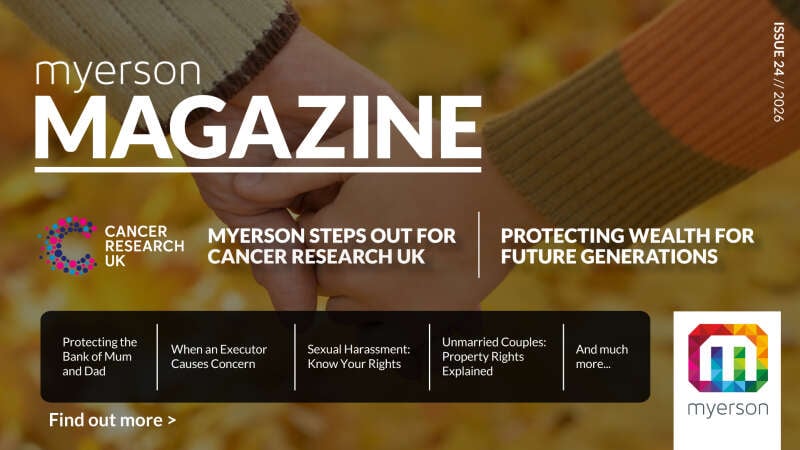
Myerson Magazine Autumn 2026 Issue
Welcome to the latest edition of Myerson Magazine, where we share practical legal advice, expert insights and news from across Myerson Solicitors. In this issue, we cover some of the important legal considerations that arise at different stages of life, from protecting family wealth and planning for the next generation to understanding your...
Read Newsletter
AI In the Workplace: Employment Law Risks Employers Should Be Aware Of
AI is very quickly changing the way the modern workplace operates. It is being used for streamlining the recruitment process, analysing productivity and absence data, drafting documents and helping with various other routine administrative tasks. In the UK, the rate of adoption of AI by companies has increased greatly with survey findings showing...
Read Blog
Employment Law Autumn Update
With significant employment law reforms approaching, employers need to understand not only what is changing but also the practical steps they should be taking to prepare their organisations. In this webinar, Myerson’s Employment Law specialists discuss the latest legislative developments, employment law reforms and key case law affecting UK...
Watch Webinar
Financial Services: Emerging Legal Risks and Regulatory Change
Financial services regulation continues to evolve rapidly, creating new legal, regulatory and compliance challenges for firms operating across the sector. In this webinar, Myerson’s Financial Services specialists discuss key developments affecting financial services businesses, from employment law and regulatory conduct to cryptocurrency...
Watch Webinar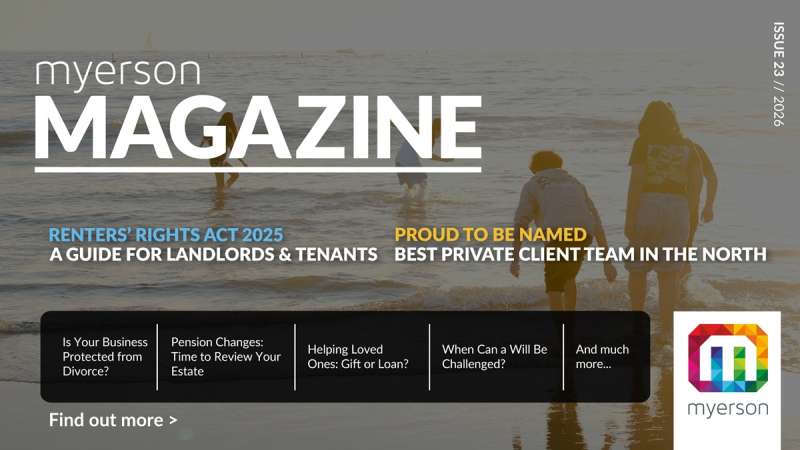
Myerson Magazine Summer 2026 Issue
We're pleased to share the latest issue of Myerson Magazine, bringing together practical legal insights, updates on significant legislative changes and stories from across the firm. In this Summer edition, our experts explore the legal issues affecting individuals, families, business owners and property investors, from the Renters' Rights Act and...
Read Newsletter
Restrictive Covenants for Accountancy Firms: A Practical Drafting Checklist
Restrictive covenants can be a powerful safeguard, but they are only effective if they are well drafted and carefully tailored. Overly broad covenants that are wider than necessary are unlikely to be enforceable, leaving firms exposed precisely when they need protection the most. Our Professional Services Lawyers have created a checklist...
Read Blog
Isobel Barton
Associate
Isobel is an Associate in the award-winning Employment team at Myerson. Isobel earned a First-Class degree in the Mlaw Exempting Degree with a combined LPC from Northumbria University in Newcastle, graduating in 2019. She joined Myerson as a Trainee Solicitor in September 2022 and qualified as a Solicitor in September 2024.
About Isobel Barton