


The sale of any business (or company) will often be complex and time-consuming.
The more preparation you do (as a seller), the more time you can save and the less stressful the process becomes.
When selling a technology business in particular, it is vitally important to consider which assets and rights you intend to sell to a buyer, and which obligations the buyer will assume.
This is not an easy task, especially if the seller plans to continue to operate its connected or complementary business following the sale.
As a prerequisite to any sale, a buyer will undertake due diligence on the business (and the company). A seller should therefore undertake its own due diligence investigation before engaging with prospective buyers.
This would involve a review of the business and its operations from a potential buyer's perspective.
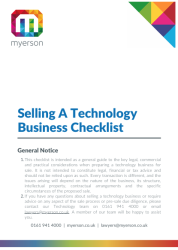
Our Corporate Solicitors explore the key issues to consider when selling a technology business and provide a free downloadable checklist to help you identify potential legal issues before entering the sale process.


1. Intellectual Property
Intellectual property (IP) is often one of the most valuable assets of a technology business.
A potential buyer will want to ensure it acquires all material IP rights as part of the transaction.
Sellers should therefore conduct a thorough review of the IP used within the business and verify ownership of all key assets.
Where the seller forms part of a wider group of companies, it is important to establish which group entity owns the relevant IP and whether ownership aligns with the business being sold.
If IP does not sit within the appropriate entity, assignments and licences should be put in place before the sale process begins.
A further key issue is confirming that the business owns the IP it believes it owns, particularly where proprietary software, algorithms, platforms or other technology represent a significant proportion of the business's value.
Where a third-party developer for the business has created IP, it is advisable to ensure that there is a written agreement in place with the third-party developer and that the IP has been correctly assigned to the business, as the default position under the law is that the IP is the property of the creator (i.e. the third party developer, even where the business has paid for such development work).
If no terms are in place or these rights have not been assigned, the technology business may seek confirmatory deeds of assignment of such IP before completion.
A seller should also ensure any registrable IP is registered so that the public records reflect the actual position.

2. Artificial Intelligence and AI Assets
As AI becomes increasingly integrated into technology businesses, buyers are paying closer attention to AI-related assets and risks.
Sellers should review:
- Ownership of AI models, datasets and related technology;
- Rights to use data utilised for AI training purposes;
- Third-party AI tools incorporated into products or services;
- Contractual restrictions contained within AI platform licences; and
- Governance procedures relating to AI development and deployment.

3. Outsourcing
Technology businesses often provide outsourced services for their customers.
The seller should ensure that all its outsourcing terms are up to date, including any service levels and data processing terms provided to its customers.
A key issue to identify is whether transferring the technology business to the buyer will trigger a transfer of employees under the TUPE Regulations 2006.
To prepare for this, a seller should identify those employees who are or may be in the pool of transferring employees at the time of the transfer, as this will not only assist with the due diligence process but also with the seller's obligation to provide specified 'employee liability information' at least 28 days before the transfer.

4. Licensing
Many technology businesses operate as resellers, supplying products or services provided by third parties, such as software vendors or cloud service providers.
Where the target resells software under a licence agreement, a buyer will want to review the terms of that agreement to understand the obligations it may assume or inherit following completion.
Sellers should ensure that written licence terms are in place and that existing licence arrangements are reviewed before the sale process begins.
This can help avoid a situation in which completion puts the buyer in breach of the licence or gives the licensor the right to terminate.
If a licence agreement contains a change of control provision, the seller should consider at an early stage whether licensor consent will be required to avoid delays to the transaction timetable.
Technology businesses should also review their standard licence terms and consider whether their licensing model has evolved over time.
In particular, care should be taken when licensing software on a perpetual basis for a lump-sum fee, as this may risk characterisation as an economic equivalent to a sale of the software to the customer.
Another key issue for buyers is the extent to which the target's proprietary software incorporates or integrates open-source software (OSS).
A useful preparatory exercise for sellers is to review their software for OSS components and identify the licences under which those components are made available.

5. Data Protection
Many technology businesses process a large amount of data.
After acquiring a target business, a buyer will want to ensure it complies with data protection legislation, as large penalties can be imposed for non-compliance.
Therefore, a seller should ensure adequate data protection policies are in place, both internally (regarding its employees) and externally (regarding its customers).
There are also many ways a technology business may transfer data outside of the UK, such as when it provides hosting services using servers based elsewhere, when data is transferred between international group members, or when it relies on third-party service providers based outside of the UK.
In such circumstances, the seller should ensure appropriate measures to protect the transferred personal data and consider whether additional contractual terms are required to ensure the legal transfer of personal data.

6. Group Structures
If the business is part of a larger group of companies, it should identify and consider how to deal with any assets, contracts, systems and services shared across the group.
In particular, if proprietary software or other technology is essential to the group's business and will have to remain with other group members post-sale, then assignments and licenses will need to be put in place before completion.
Also, a buyer may require the seller or its group to continue providing certain services or resources for a period following completion (until the buyer integrates the business into its group or procures the services from a third party).
This will most commonly be provided in a transitional services agreement. The scope and extent of the services required must be ascertained as soon as possible.

7. National Security and Investment Act Considerations
Certain technology businesses may fall within sectors subject to scrutiny under the National Security and Investment Act 2021 (NSIA).
Particular care should be taken where the business operates in areas such as:
- Artificial intelligence;
- Data infrastructure;
- Communications;
- Computing hardware;
- Cryptographic authentication;
- Quantum technologies; or
- Other sensitive technology sectors.
Depending on the nature of the transaction and the target's activities, notification requirements may apply, and government approval may be required before completion.
Failure to identify NSIA issues early can lead to significant delays and increased transaction risk.

Download Our Free Checklist
Download our free Selling a Technology Business Checklist to help you prepare your business for sale, identify key legal, commercial and practical issues, and get ahead of buyer due diligence.
Whether you're planning a sale in the near future or simply want to understand what buyers will be looking for, this practical checklist provides a useful starting point for your preparation.
This checklist is provided as a general guide only and does not constitute legal, financial or tax advice. Every business sale is different, and the issues you need to consider will depend on the nature of your business and the proposed transaction. If you require advice tailored to your circumstances, please contact our Corporate and Technology team.
Contact Our Corporate Solicitors
A seller should consult professional advisors early to ensure the sale process is as smooth as possible and that issues are identified and dealt with as early as possible. This will also mean you can concentrate on running your business.
If you would like any assistance with any aspect of preparing your business, please get in touch with one of our
Corporate Lawyers or Technology Solicitors:
01619414000
More Corporate and Technology News

Family Investment Companies: The Legal Framework Behind Effective Governance
A family investment company (commonly known as a FIC) is not a distinct legal entity created by special legislation. It is usually a private company limited by shares, incorporated under the Companies Act 2006 with a constitution and share structure that has been constructed or adapted to hold and manage family investments in a tax-efficient...
Read Blog
International M&A: Key Concepts Every Business Should Understand
International mergers and acquisitions (M&A) are an increasingly important way for businesses seeking growth beyond their domestic markets. Whether acquiring an overseas competitor, entering a new jurisdiction, securing innovative technology, or attracting foreign investment, cross-border transactions can unlock significant opportunities...
Read Blog
Myerson Announces Six Partner Promotions as Firm Continues Organic Growth into the New Financial Year
Myerson Solicitors is pleased to announce six promotions to Partner as part of a record year of career progression, with 13 promotions across the business in 2026. These appointments follow the recent announcement that Richard Lloyd has succeeded Carl Newton as Chief Executive, marking a new chapter for the firm as it continues its ambitious...
Read News
Charity Trustees: Key Duties and Governance Risks
The International Day of Charity , marked each year on 5 September, highlights the importance of global charity work in addressing humanitarian crises, alleviating poverty and responding to a range of social issues. Whilst the day celebrates the positive impact of charities, their ability to deliver that impact depends heavily on effective...
Read Blog
Accountancy Practice Succession and Exit Planning: A Legal Guide
For many accountancy practice owners, building a successful business can take decades. Yet when the time comes to retire, reduce involvement, or move on to a new venture, the absence of a clear exit strategy can significantly impact both value and continuity. Whether your objective is to achieve a clean exit, secure the long-term future of the...
Read Blog
Financial Services: Emerging Legal Risks and Regulatory Change
Financial services regulation continues to evolve rapidly, creating new legal, regulatory and compliance challenges for firms operating across the sector. In this webinar, Myerson’s Financial Services specialists discuss key developments affecting financial services businesses, from employment law and regulatory conduct to cryptocurrency...
Watch Webinar
Jonathan Garner
Associate
Jonathan is an Associate in the Corporate Commercial team and has built an extensive background in corporate law, advising on a wide spectrum of transactions including sales, acquisitions, management buy-outs, investments, private equity transactions, reorganisations, and general corporate governance matters. His experience spans both domestic and cross-border work, giving him a broad understanding of the commercial, strategic and operational considerations that shape complex deals.
About Jonathan Garner