


Many businesses appoint commercial agents to help expand into new markets. But what happens when an agent appoints someone else to help them?
Our Commercial Agency Lawyers explain the difference between commercial agents and sub-agents and explain:
- What commercial agents and sub-agents are
- What rights each has, especially upon termination
- When the Commercial Agents (Council Directive) Regulations 1993 apply
- How contractual arrangements differ
- What limited recourse sub-agents might have upon termination
What is a commercial agent?
A commercial agent is a self-employed intermediary who negotiates or concludes sales or purchases of goods on behalf of a principal.
By way of example:
PrincipalCo is a UK-based manufacturer of fabrics. It appoints AgentCo as its agent for England. AgentCo negotiates sales contracts with local retailers directly on behalf of PrincipalCo and is paid a commission on the value of sales generated.
Since AgentCo acts directly for the principal, it is protected by the Commercial Agents (Council Directive) Regulations 1993 (the Regulations) and is entitled to receive compensation or an indemnity payment upon termination of its agency contract.

What is a sub-agent?
A sub-agent is appointed by the main agent to carry out some or all of the agent’s activities. The sub-agent may sell the principal’s products but has no direct contractual relationship with the principal.
Let’s look at another example:
AgentCo wants better coverage in England, so it appoints SubCo as a sub-agent to manage sales in the area. The contract is between AgentCo and SubCo. SubCo reports to AgentCo, and not to PrincipalCo. Its commission is paid by AgentCo, and not by PrincipalCo.
Since SubCo is not directly appointed by the principal, it is not a commercial agent under the definition of the Regulations, and therefore it is not entitled to compensation or an indemnity payment upon termination of its sub-agency.

Applicability of the Regulations – summary
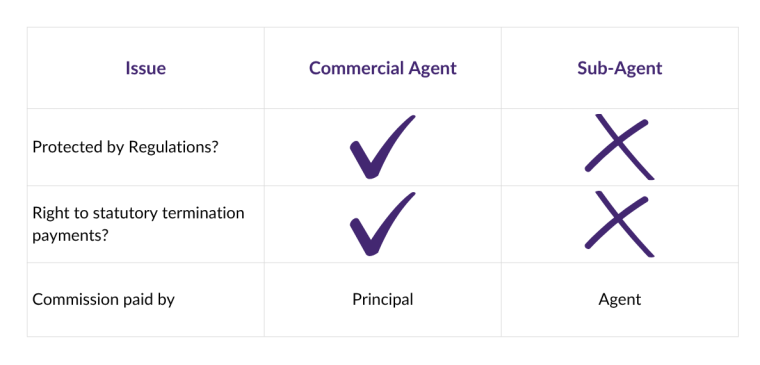
Recourse available to sub-agents
In summary, upon termination of a sub-agency:
- Sub-agents cannot claim compensation or indemnity from the principal under the Regulations.
- Sub-agents may be entitled to bring a claim against the agent where:
- The sub-agency agreement includes express termination payments or notice provisions; or
- The agent acts in breach of contract for example if the agent terminates the sub-agency without providing the requisite period of notice.

A share in the agent’s claim?
If an agent’s contract is terminated by the principal, that will usually result in the agent terminating the sub-agent’s contract. In the circumstances, it is only the agent who can claim compensation or an indemnity payment.
The sub-agent has no recourse against the principal because it does not have a contract with the principal. But might a sub-agent have an entitlement to a share in the agent’s claim?
The court has suggested that whilst sub-agents are not protected by the Regulations, they may be able to establish a stake in the managing agent’s post-termination payment.
The problem for sub-agents, however, is whether they would be able to compel the managing agent to bring a claim against the principal and/or whether the agent would be bound to exercise its rights in the sub-agent’s best interests.
Absent express terms of the contract, these may be difficult arguments to bring.

Conclusion
The distinction between commercial agents and sub-agents is important as it determines who gets paid what, who is legally protected, and the consequences of termination.
Unless and until there is a further development in the law, sub-agents are not protected by the Regulations and are not entitled to post-termination payments, and sub-agents should be aware of this when negotiating contracts with agents.

Contact Our Commercial Agency Solicitors
Our team of experts are ready to assist on all aspects of commercial agency law. We are always happy to have an initial no-obligation chat to help guide you in the right direction. Please do not hesitate to contact us below.
0161 941 4000
Latest Myerson Dispute Resolution News

Myerson Secures Substantial Settlement for Commercial Agent
Myerson Solicitors' Commercial Agency specialists are pleased to have secured a substantial settlement for a commercial agent operating in the lighting controls and building technology sector following the termination of a long-standing agency relationship with a UK supplier.
Read Blog
28
Restrictive Covenants: Managing Risks When Key Employees Move On
Leaving a business or facing the departure of a key employee? Learn the risks, rights and remedies in restrictive covenant disputes. When a senior employee leaves, both the individual and the business can face difficult questions about restrictive covenants, client relationships and post-termination obligations. Whether you are considering a move...
View Event
Myerson Secures Construction Adjudication Success on Major MOD Infrastructure Project
Myerson's Commercial Litigation team has successfully acted for a leading provider of professional infrastructure and managed network services in an adjudication arising from a payment dispute with another contractor on a major Ministry of Defence infrastructure project . David Jones and James Griffiths of the Commercial Litigation team led the...
Read Blog
Myerson Successfully Defends Grounds Maintenance Contractor in High Court Restrictive Covenant Injunction Case
Myerson Solicitors is pleased to have successfully defended a grounds maintenance sub-contractor in a restrictive covenant dispute in London, securing a favourable outcome and achieving a significant recovery of the client’s legal costs. The matter was led by David Jones , with support from Kit Bevan of Myerson's Commercial Litigation team, who...
Read Blog
Vesting Order Success: Recovering £600,000 of Bona Vacantia Property from the Crown
Myerson’s David Jones and Amna Iqbal recently acted for a client in a complex matter involving two valuable investment properties worth in the region of £600,000. The properties had unintentionally vested in the Crown as bona vacantia following the strike‑off and dissolution of the client’s company due to the negligence of their former...
Read Blog
Myerson Marks January Milestones for Long-Serving Colleagues
Myerson Solicitors is marking January milestones for three long-serving colleagues, recognising their contribution to the firm’s growth over the past two decades. M. Akeel Latif and Adam Maher , both Board Members and recognised by Legal 500 as Leading Partners, are celebrating 25 years and 20 years with Myerson respectively. Both were involved...
Read News
Robert Brothers
Partner
Rob has experience acting as a Dispute Resolution solicitor. Rob has specialist expertise in professional negligence disputes, shareholder and partnership disputes, complex contractual disputes, intellectual property, reputation management and commercial agency claims.
About Robert Brothers